Most commuters board a train expecting a routine journey: headphones on, eyes on the phone, destination in mind.
But on Shanghai’s Metro Line 11, the daily commute has suddenly acquired a roar.
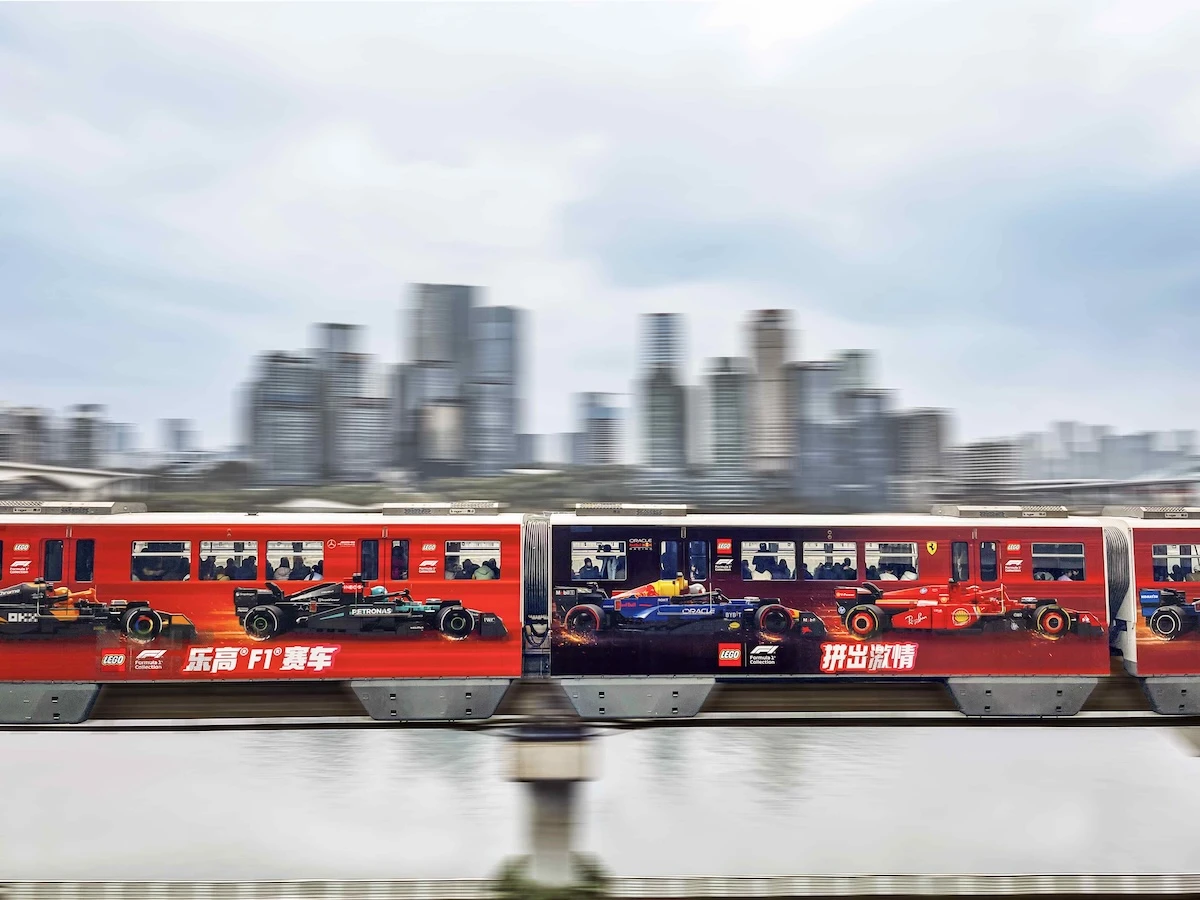
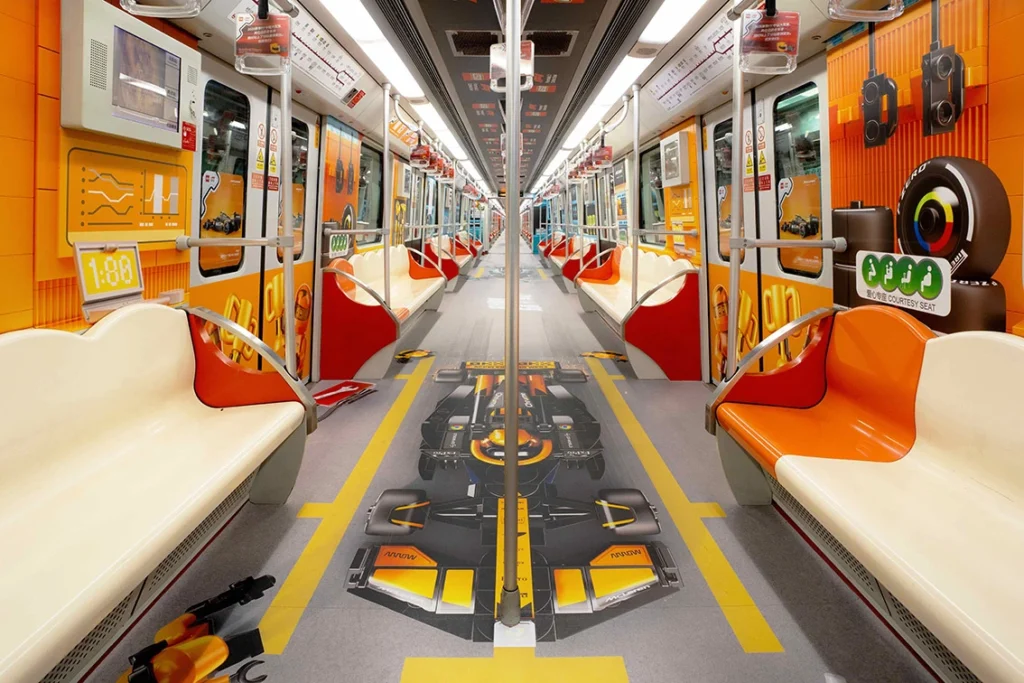
To mark the return of the Chinese Grand Prix, LEGO China has transformed an entire metro train into a full-scale Formula 1-inspired experience, turning one of the city’s busiest transport lines into what looks like a racing machine tearing through the underground.
The concept is simple, theatrical, and unmistakably LEGO: if you can’t bring millions of commuters to the race track, bring the race track to them.
A Metro Train Disguised as a Formula 1 Car
The exterior of the train has been wrapped so that, when viewed from platform level, it resembles a single elongated Formula 1 car stretching across multiple carriages.
From nose cone to rear wing, the illusion is striking.
As the train accelerates out of stations, the visual effect is that of a racecar blasting through the Shanghai underground—a clever piece of motion-based storytelling that only works in transit media.
The line itself makes the activation even smarter.
Metro Line 11 connects central Shanghai directly to the Shanghai International Circuit, the home of the Chinese Grand Prix.
On race week, the train effectively becomes the first lap of the race, carrying fans toward the circuit.
It’s outdoor advertising. But with wheels.
Turning a Commute Into a Spectacle
The real genius of the campaign lies in its public theatre.
Transit advertising usually blends into the background.
This one refuses to.
Passengers stop to photograph it.
Commuters film the train pulling into stations.
Social feeds fill with clips of a “Formula 1 car” sliding into a metro platform.
The activation essentially turns commuters into content creators, amplifying the campaign far beyond the subway system itself.
In marketing terms, it hits three sweet spots simultaneously:
It’s experiential marketing disguised as public transport.
Extending the Idea Into the Sky
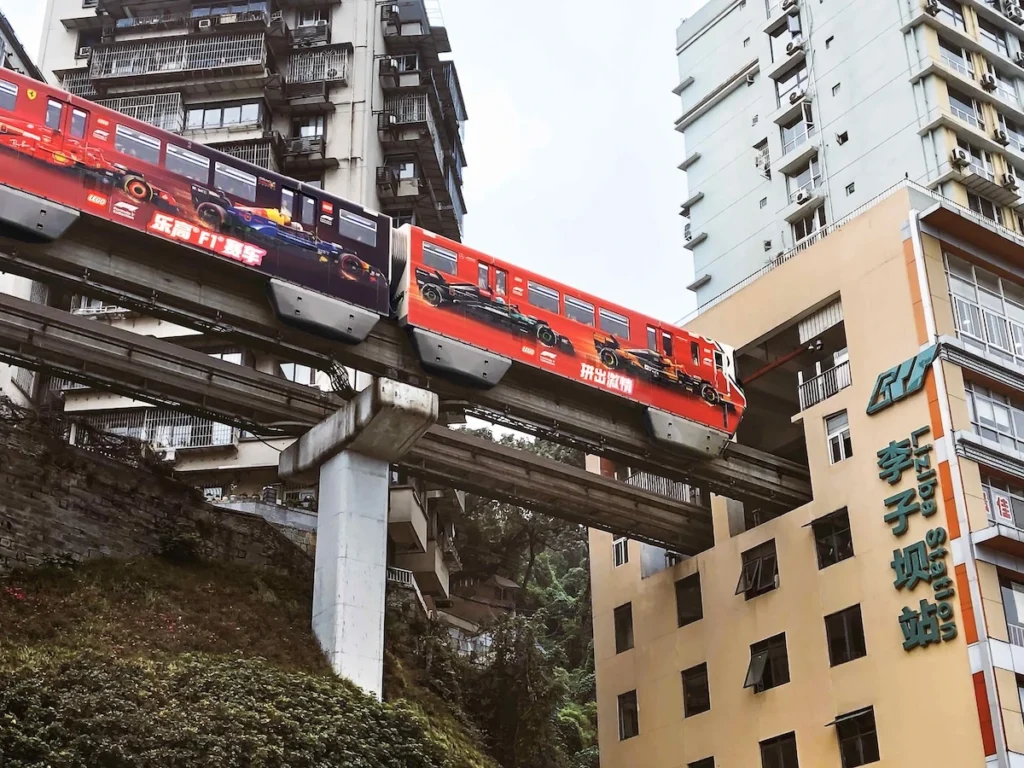
The campaign also nods to one of China’s most famous urban spectacles: Chongqing Rail Transit Line 2, where a train famously passes through a residential building.
In LEGO’s campaign visuals, that train is reimagined as a flying Formula 1 machine bursting through the skyline, extending the narrative from underground race tracks into the air.
It’s a playful reference that Chinese audiences instantly recognise.
Like all good LEGO storytelling, it blurs the line between the real world and imagination.
Why This Campaign Works
For marketers, the lesson is refreshingly straightforward.
Rather than relying on screens, influencers or algorithmic media buys, LEGO has returned to something older and arguably more powerful: spectacle in the physical world.
Three strategic insights stand out:
1. Infrastructure as media
A metro line becomes a moving billboard seen by millions daily.
2. Motion as storytelling
The faster the train moves, the more convincing the Formula 1 illusion becomes.
3. Culture-first creativity
By referencing Chongqing’s famous train-through-building moment, the campaign taps into a shared national visual memory.
It’s the sort of activation that reminds marketers that sometimes the most powerful medium isn’t digital.
It’s the city itself.