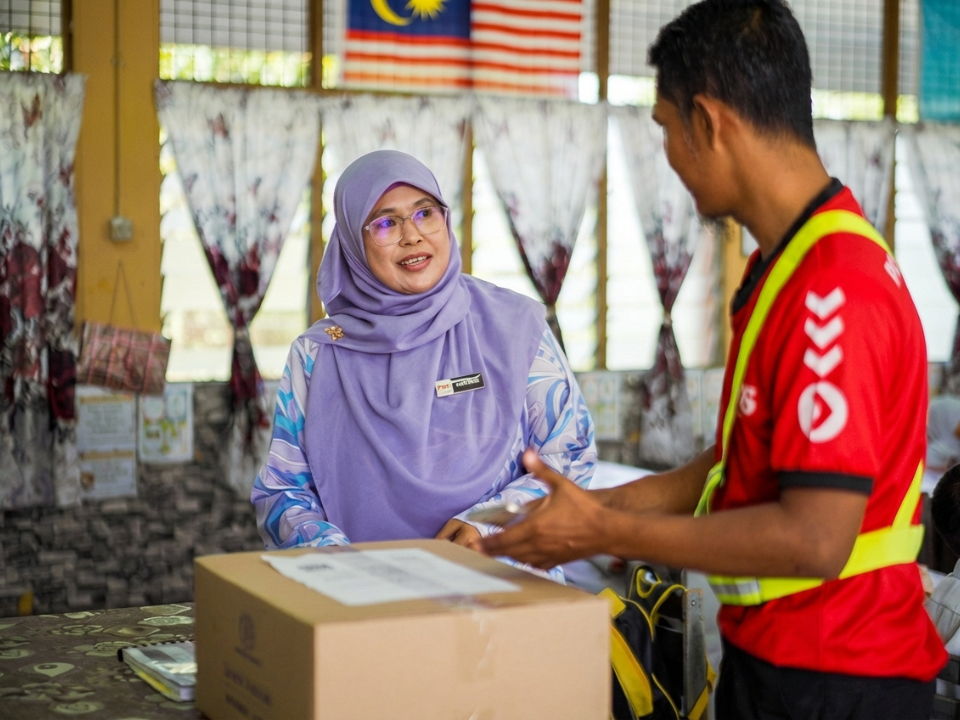
When a postman turns up at your gate, you expect a parcel. Not a promise.
Yet that is precisely what Pos Malaysia Berhad is delivering this school term — not just packages, but possibility.
In collaboration with Perbadanan Kota Buku, the national postal operator has helped distribute more than two million recycled exercise books to B40 students nationwide under the initiative “Two Million Recycled Exercise Books: Driving Sustainable Education.”
At first glance, this looks like a corporate CSR story.
But look closer and it reveals something more strategic: a legacy brand repositioning its network as infrastructure for impact.
A Logistics Giant with a Social Spine
With a last-mile network that reaches over 11 million addresses daily, Pos Malaysia operates at a scale no other logistics player in the country can match.
It reports next-day parcel delivery rates above 90% — comfortably ahead of the industry’s 82% benchmark — and on-time mail performance of 93%.
But scale without purpose is just muscle.
Through Pos Care, its dedicated social impact arm, the company has channelled that operational heft into something far more human.
In Phase II alone, over 4,120 schools under the Ministry of Education have received recycled exercise books, benefitting more than 200,000 students.
For B40 families, this translates into tangible relief: an estimated RM2.4 million in collective savings.
For marketers, it signals a shift.
This is not about logo placement on a charity banner.
It is about embedding brand utility into a national issue.
Turning Waste into Worth
The programme, led by Kota Buku under the Ministry of Education, produces exercise books made entirely from recycled paper.
In doing so, it prevents the loss of approximately 2,832 trees — a sustainability statistic that matters in boardrooms increasingly measured by ESG scorecards.
Yet the real power of the story lies in its simplicity.
In states such as Perlis, Kedah, Penang, Perak, Kelantan and Terengganu, where financial strain can make even basic school supplies a burden, deliveries began in January 2026 and were completed within the same month.
That operational precision matters.
Social programmes often falter not because of lack of intent, but lack of execution.
Here, logistics is not an afterthought; it is the enabler.
Brand Purpose in Action — Not in a Deck
Group Chief Marketing Officer Fiona Liao summed it up succinctly: the company is “passionate about building trust to connect lives and businesses for a better tomorrow.”
Marketers have heard variations of that sentence before.
The difference here is alignment.
The initiative connects three powerful currents shaping Malaysian brand strategy in 2026:
In an era where purpose-led campaigns are often criticised for being cosmetic, this partnership demonstrates what happens when corporate infrastructure intersects with public need.
The Bigger Marketing Lesson
For agencies and brand custodians reading this, the takeaway is not “do more CSR.”
It is this: identify the asset only you possess, and deploy it in service of something larger.
For Pos Malaysia, that asset is a nationwide last-mile network refined over decades.
For others, it might be data, retail footprint, media inventory, or technological capability.
The future of meaningful marketing will not be decided by who shouts loudest about purpose.
It will be decided by who can operationalise it.
As the 2026 school year gathers pace, two million recycled books now sit on classroom desks across Malaysia.
They carry no flashy campaign slogan. Just blank pages waiting to be filled.
Sometimes the most powerful brand story is not printed in the ad.
It is written by the hands that receive it.
Share Post:

The APPIES is where Malaysia’s boldest campaigns, brightest ideas, and most impactful storytellers take the stage.
More than an awards show, it is the industry’s ultimate platform for creative, media, digital and marketing excellence, where live presentations meet live judging.
This is your chance to showcase work that moved audiences, shaped conversations, and delivered real results.
From breakthrough brand campaigns to innovative digital experiences, the APPIES celebrates the work that defines the future of marketing.
Step into the spotlight alongside the industry’s leading agencies, brands, creatives, strategists and changemakers.
Whether you are aiming for Gold, Silver, Bronze or the prestigious Best of the Best recognition, this is your moment to make history.
Your campaign deserves to be seen.
Your ideas deserve the stage.
Your work deserves the legacy.
KEY DATES
Haven’t subscribed to our Telegram channel yet? Don’t miss out on the hottest updates in marketing & advertising!