For decades, marketing was built around a simple privilege: brands controlled the microphone.
They chose the claim, framed the story, commissioned the imagery and bought the media. Consumers could disagree, but they rarely possessed the tools to challenge the narrative at scale.
That privilege is gone.
Today, a product claim can be checked in seconds. A creator partnership can be traced. A sustainability promise can be interrogated. An AI-generated image can become the story instead of the campaign. One disgruntled customer with a phone can sometimes do more reputational damage overnight than millions spent polishing a corporate narrative.
In this environment, “the truth will set you free” is no longer merely a moral proposition. It is becoming a marketing strategy.
Trust is now a product attribute
The numbers are striking.
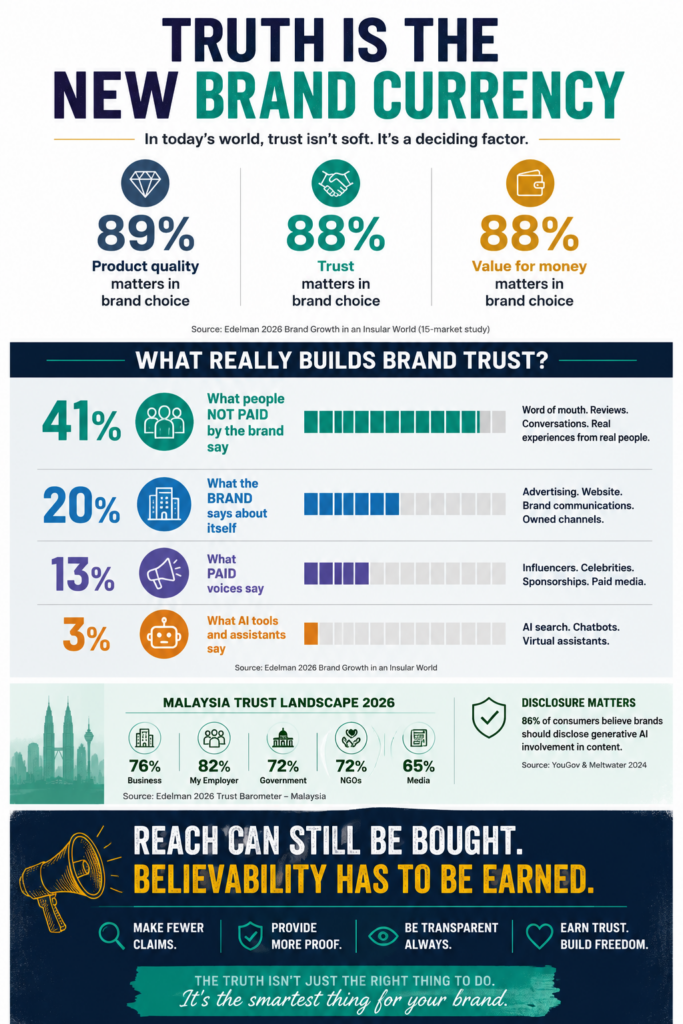
Edelman’s 2026 Brand Growth in an Insular World study found that 88% of consumers across 15 markets consider trust important or a critical deal-breaker when choosing brands. That puts trust level with value for money at 88%, and only one percentage point behind product quality at 89%.
More tellingly, brands themselves now enjoy a remarkable trust advantage. Across the markets measured, trust in brands reached 72% in June 2026, compared with 56% for institutions.
That creates opportunity. But it also creates responsibility.
In Malaysia, the 2026 Edelman Trust Barometer puts the overall Trust Index at 71%. Business scores 76%, while trust in “my employer” stands even higher at 82%. Government and NGOs are at 72%, with media at 65%.
For marketers, this should not be interpreted as permission to say more.
It is an obligation to prove more. Because consumers increasingly distinguish between what brands claim and what others can verify.
Edelman found that the biggest influence on willingness to trust a brand is what people not paid by the brand say about it, cited by 41%. What the brand says about itself accounts for just 20%. Paid voices register 13%. AI tools and assistants, despite the enormous attention surrounding AI search, account for only 3%.
That may be the most important media lesson of 2026: Reach can still be bought. Believability increasingly has to be earned.
The synthetic truth problem
Generative AI makes this tension sharper.
Marketers can now create people who never existed, locations never visited, product environments never photographed and advertising at industrial speed.
The technology itself is not the problem. Concealment is.
Research from YouGov and Meltwater involving nearly 10,000 consumers across seven countries found that 86% believe brands should disclose generative AI involvement in content. Another 32% say they trust brands less when content is AI-generated.
The lesson is not “do not use AI”. It is: do not make your customer feel tricked.
Malaysia already has an important principle in place. The Malaysian Communications and Multimedia Content Code requires advertisements and marketing communications to be clearly identifiable, including reviews, endorsements and testimonials arising from commercial arrangements.
Commercial persuasion should never masquerade as independent truth. That principle becomes even more important in an AI-powered marketing ecosystem.
Truth is not perfection
There is another misconception brands need to abandon. Being truthful does not mean pretending to be flawless. In fact, relentless perfection can itself look suspicious.
A credible brand can admit that a delivery failed, a product disappointed, a campaign missed the mark or an AI experiment went wrong. The trust-building moment is often not the mistake, but what happens immediately afterwards.
Consumers have become remarkably fluent in corporate language. They recognise the difference between an apology designed to minimise liability and one that accepts responsibility.
The stronger discipline is therefore simple:
Make fewer claims. Provide more proof.
Show the sourcing. Explain the price increase. Name the limitation. Label the sponsored creator. Disclose meaningful AI involvement. Substantiate the sustainability claim. Correct the error before the internet corrects it for you.
This becomes particularly important in Malaysia, where brands communicate across languages, cultures, faiths and communities. Trust becomes fragile when audiences suspect one version of the story is being presented to one community and another somewhere else.
Consistency itself becomes a form of truth.
The freedom truth creates
There is commercial freedom in all this. A brand that tells the truth does not have to remember which version of the story it told yesterday.
Its employees can speak with confidence. Its agencies can create without constantly defending inflated promises. Its customers become advocates because their lived experience resembles the advertising.
That is where brand equity begins to compound. The future of marketing will undoubtedly become more automated, personalised and synthetic.
Paradoxically, that will make something very old considerably more valuable. The truth. Not as a slogan. As a competitive advantage.