A new World Cup social intelligence report suggests the old sponsorship equation is breaking down. Adidas proved official status can still dominate when properly activated. But Kalshi’s 126-million-view creator hit and the wider success of Levi’s, Nike and LEGO showed that cultural relevance can now outrun the size of the rights cheque.
The 2026 FIFA World Cup may have been a commercial juggernaut, but one of its most important marketing lessons came from brands that did not own the biggest sponsorship rights.
FIFA had sold out every global sponsorship position before the tournament began, describing the 2026 commercial programme as the most successful in its history.
Sponsorship partnerships alone were projected to contribute around US$2.7 billion to FIFA’s four-year cycle. Yet the battle for consumer attention told a rather different story.
According to a new social intelligence study by Nectar, four of the tournament’s top-performing brands were non-sponsors. The company analysed more than 2.7 million pieces of World Cup-related content across TikTok, Instagram, YouTube, Reddit and X, collectively generating more than 64 billion impressions.
Its conclusion should make every chief marketing officer signing a multimillion-dollar sponsorship agreement pause.
A sponsorship buys access. It does not automatically buy attention.
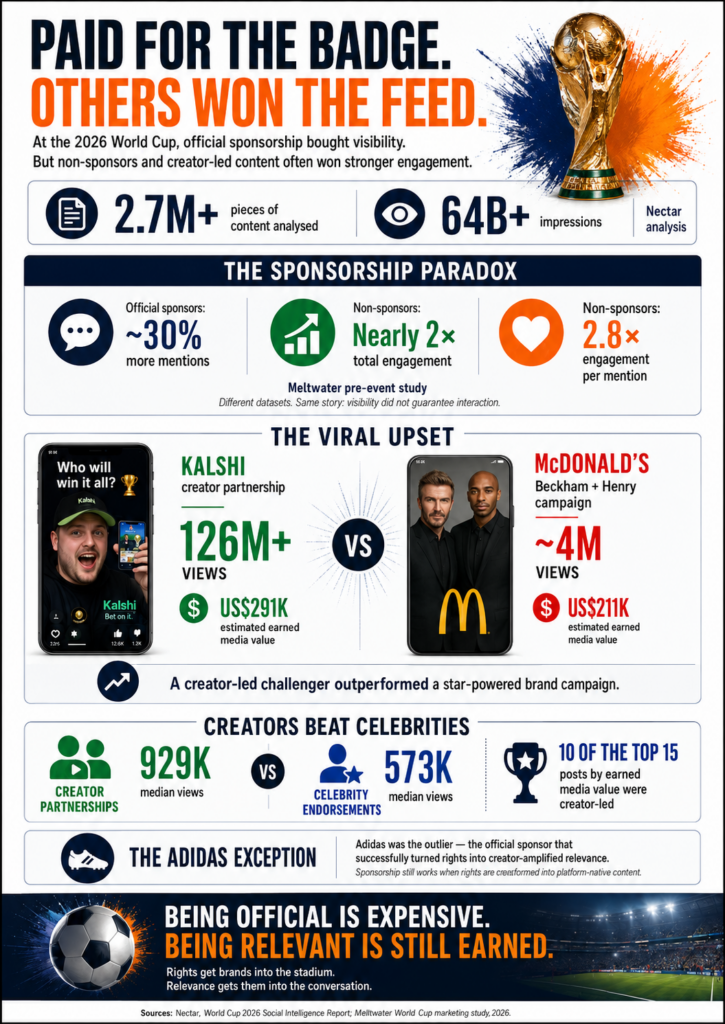
Nectar found that, after Adidas, some of the strongest engagement performers were non-sponsors or licensees including Levi’s, Nike and LEGO — outperforming official partners including Coca-Cola, Qatar Airways and Aramco on engagement measures.
The numbers expose an increasingly important distinction between being seen and being interesting. Coca-Cola, for example, generated approximately 250 million views in Nectar’s analysis, but an engagement rate of only 1.3%.
Puma attracted a fraction of that reach around two million views but delivered engagement of 6.2%. In other words, buying or securing enormous visibility does not mean audiences will do anything with it.
Then there was Kalshi.
The prediction-market platform produced what Nectar identified as the tournament’s biggest earned-reach hit through a creator partnership.
A post involving creator @jonerfatcat generated more than 126 million views and an estimated US$291,000 in earned media value.
Compare that with the heavyweight combination of David Beckham and Thierry Henry for McDonald’s: roughly four million views and US$211,000 in estimated earned media value.
Two of football’s most recognisable global icons were comprehensively out-reached by a creator whose audience, format and content instincts were native to the platform.
That is not an argument that celebrities have suddenly become irrelevant. It is an argument that distribution has changed.
Across the campaigns Nectar examined, creator partnerships recorded median views of 929,000 compared with 573,000 for celebrity endorsements. Ten of the top 15 posts ranked by earned media value were creator-led.
There is an important nuance. Kalshi was not a direct FIFA sponsor, although during the knockout stage it subsequently entered a co-branded partnership with ADI Predictstreet, FIFA’s official prediction-market partner.
Even so, its breakthrough illustrates how a challenger can build enormous attention before acquiring anything resembling traditional tournament visibility.
Adidas proved sponsorship is not dead
There was one spectacular exception to the apparent sponsor disadvantage.
Adidas.
Nectar ranked the brand first across reach, engagement and earned media value. The difference was that Adidas did not treat sponsorship as a media placement.
It treated it as raw material.
Its advantages were formidable: official FIFA status, the match ball, teams, players, products and decades of football credibility. But Adidas then pushed those assets through creators and fan-native content rather than relying entirely on its own channels.
Its five-minute celebrity-packed “Backyard Legends” film generated 6.5 million views on Adidas’ own TikTok account. When creator BABOY posted the same advertisement, it approached 12.7 million.
Another Adidas collaboration with football creator @elefutbol, built around Lamine Yamal, generated 11.7 million views and 2.2 million likes.
The lesson is subtle but significant.
The creator is increasingly becoming the media channel. Adidas had the stars. Creators provided the distribution architecture. Levi’s offered another masterclass.
FIFA’s clean-stadium rules required the Levi’s branding at Levi’s Stadium in Santa Clara to be covered because the denim company was not an official tournament sponsor.
Instead of disappearing quietly, Levi’s turned the covered logo into content, adopting the obscured identity across social media and extending the joke beyond the stadium.
FIFA removed the name. The internet restored the brand.
It worked because Levi’s possessed something sponsorship money cannot instantly purchase: distinctive brand memory. Even concealed, people recognised it.
And the pattern had emerged even before kick-off. Meltwater’s separate analysis of 2.4 million World Cup-related mentions between January and June found that official sponsors generated around 30% more mentions, yet non-sponsor collaborations produced nearly twice the total engagement and 2.8 times the engagement per mention.
Reported engagement stood at roughly 61 million for non-sponsors versus 33 million for official sponsors.
For marketers in Malaysia and across Asia, the implication extends far beyond football. Do not confuse ownership of an event with ownership of the conversation.
Rights remain enormously valuable. They provide intellectual property, access, exclusivity and experiences competitors cannot legally replicate. But rights are now the infrastructure of a campaign — not the campaign itself.
The winning formula increasingly appears to be rights plus creativity plus creators plus cultural velocity.
The 2026 World Cup did not prove sponsorship is obsolete. It proved something considerably more uncomfortable. Being official is expensive. Being relevant is still earned.
In the algorithmic stadium where today’s brand battles are really being fought, the perimeter board may tell us who paid to be there.
The feed tells us who actually won.