There was a time when advertising men did not hide behind PowerPoint decks. They sold. Not merely products. Belief. Not just campaigns. Conviction.
They argued in smoky boardrooms, travelled dirt roads to understand consumers, fought for ideas, and occasionally risked their reputations on instincts sharpened by experience rather than algorithms.
One of those men was Idris Sheikh Ahmad.
Now, decades after helping shape some of Malaysia’s most memorable brand stories, the former advertising firebrand has returned with what may well be one of the boldest provocations to Malaysia’s marketing industry in years.
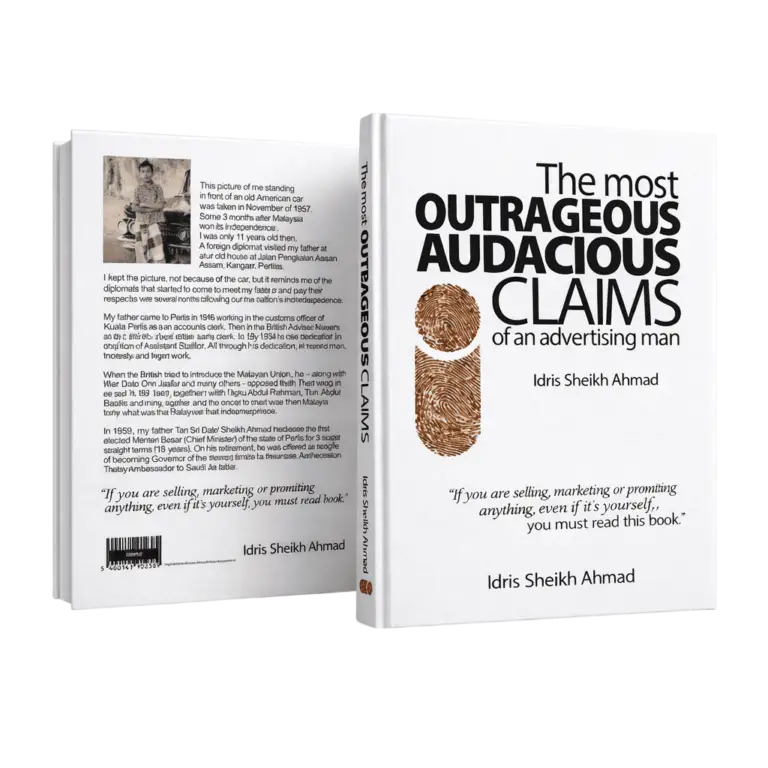
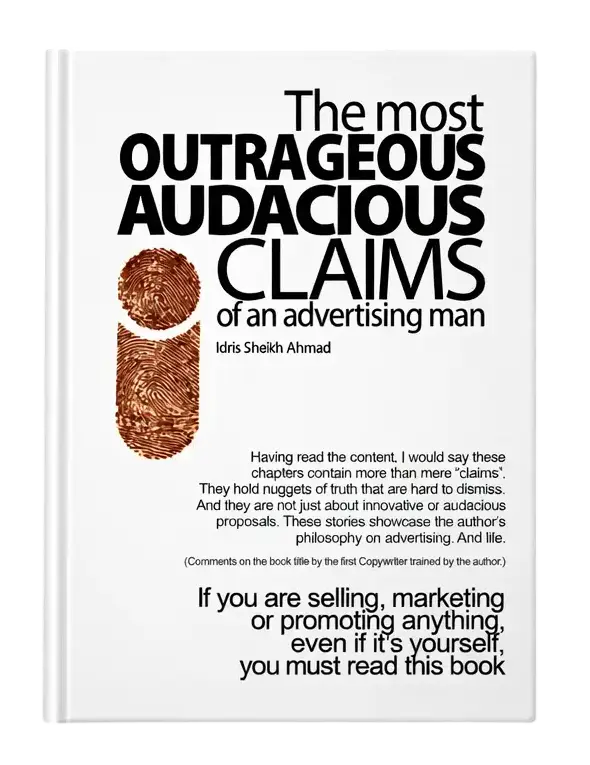
A 240-page memoir-manifesto with the unapologetically audacious title, The Most Outrageous Audacious Claims of an Advertising Man.
Part memoir, part marketing philosophy, part war diary from advertising’s rough-and-ready golden age, the book is less a nostalgic trip and more a challenge hurled at an industry that Idris believes may have mistaken noise for communication.
If the title sounds boastful, Idris would probably argue that modesty never built a brand.
The Man Before The Myth
Long before agencies became obsessed with dashboards, digital metrics and jargon-laden presentations, Idris was learning the craft at Ogilvy & Mather where discipline, research and strategic rigour were treated almost like religion.
The agency’s famous ethos — blood, sweat and tears — shaped a generation of advertising professionals who believed hard work was not punishment, but privilege.
Idris would later go on to establish Idris, Lim & Associates before building Idris Associates, one of Malaysia’s most dynamic homegrown agencies during an era when local firms punched far above their weight and often out-thought multinational rivals.
But to describe Idris merely as an “advertising man” is to miss the point entirely.
Because long before integrated marketing became fashionable, Idris and his contemporaries were already practising what today would be labelled “360-degree brand experiences”.
Only, they simply called it work. Advertising was never just about advertisements.
It was exhibitions. Sponsorships. TV programmes. Events. Concerts. Documentaries. Public experiences designed to move products and shape perceptions.
In Idris’s world, communication was not fragmented into channels. It was orchestrated.
“We were marketing our clients’ products through a system of marketing communication tools,” Idris reflects — a reminder that some of today’s “new” ideas are, in truth, old wisdom wearing fashionable clothes.
The Man Who Challenged The Work
What separated Idris, former colleagues suggest, was not simply talent. It was intensity.
Long before creative culture became sanitised by workshops and wellness rhetoric, Idris was known for relentlessly challenging every headline, every sentence and every strategic assumption.
Good was never enough. Better was expected.
Creative teams often worked at a punishing pace, fuelled by adrenaline, ambition and the stubborn pursuit of excellence. For many who passed through Idris Associates, the experience was demanding but transformative.
Some would later say the agency did not merely produce campaigns. It forged people.
That insistence on standards perhaps explains why Idris appears almost allergic to mediocrity throughout the book. One recurring theme is clear: if the work does not move people, it does not matter.
Marketing Forgot Something Important
What makes the book timely is not nostalgia. It is relevance.
At a time when brands obsess over impressions, engagement rates and performance dashboards, Idris quietly asks a deeply uncomfortable question:
Have marketers forgotten the difference between visibility and persuasion?
One of the recurring themes in the book is brutally simple: marketing communication should lead to action. Not admiration. Not applause. Sales. His argument feels almost rebellious in an age of vanity metrics.
A brand, he argues, is not what companies say it is. It is what people remember. A logo does not build a brand. Memory does. Perception does. Experience does.
That insight lands with particular force in an era where companies spend millions polishing visual identities while neglecting the harder work of shaping meaning.
The lesson sounds old-fashioned. Which may be precisely why it still matters.
When Football Sold Cigarettes
Perhaps among the book’s most fascinating revelations is Idris’s recollection of how tobacco giant Rothmans’ Dunhill brand became intertwined with Malaysian football.
To younger marketers, the idea may seem improbable, even controversial. But Idris frames it not as sponsorship for sponsorship’s sake, but as strategic marketing communication.
As both an advertising practitioner and football administrator, he recognised something powerful: football could become more than a tournament.
It could become culture.
While running Idris Associates and serving one of his biggest clients, Rothmans of Pall Mall, Idris reportedly began imagining a league that was bigger than qualification rounds and knockout fixtures.
What followed was not simply advertising. It was positioning. An act of embedding a brand into public passion.
In today’s marketing language, one might call it ecosystem building, cultural branding or experience architecture. Idris would probably just call it common sense.
When Conviction Mattered More Than Compliance
There are stories perhaps apocryphal, but entirely believable of Idris walking away from client meetings when he felt strategic conviction was being compromised.
One former colleague recalls a meeting where Idris simply packed up and told a client off.
In an industry increasingly accused of saying yes too easily, Idris belonged to a generation that believed agencies were custodians of brands, not merely vendors of creative services.
He believed in the brands he marketed. And he lived them too.
Idris drove a Range Rover bearing the number plate “R10”, and a Citroën Pallas — fittingly, another client brand. To those who worked with him, branding was never abstract theory. It was belief made visible.
Advertising Is Not An Expense
Another provocative thread running through the book is Idris’s insistence that advertising is not a cost. It is an investment.
A brand, properly built, becomes an appreciating asset. Without belief in the brand, there is ultimately little left to sell. It sounds obvious.
Yet in difficult economic times, marketing budgets are often the first to face the axe. Idris’s worldview flips that thinking on its head.
Cut communication recklessly, and brands risk slowly erasing themselves from public memory. Forgotten brands rarely recover. Perhaps that is why one endorsement in the book carries unusual weight.
Pat Steven, the first copywriter at Idris Associates and someone who witnessed the agency’s thinking up close, offers a revealing perspective on Idris’s strategic instincts.
“This is a powerful story that highlights the agility a brand needs, the ability to act decisively and respond to real threats,” she writes of one chapter.
“It also showcases the level of strategic thinking involved. More importantly, it’s an engaging personal account of Idris, as a leader who was willing to go all the way for his client, with every detail carefully executed to reflect the brand’s image.”
That observation perhaps captures the essence of the book better than any review could. This is not merely nostalgia from a veteran adman. It is strategic memory.A masterclass disguised as storytelling.
A Timely Reminder For Marketers
Perhaps the greatest value of The Most Outrageous Audacious Claims of an Advertising Man lies not in whether every story feels outrageous.
It lies in the uncomfortable possibility that Idris may simply be right. That somewhere along the way, marketing became more complicated than it needed to be.
That technology may have accelerated communication, but not necessarily improved it. And that the fundamentals — understanding people, earning trust, shaping memory and moving behaviour — remain stubbornly unchanged.
“If you do not know enough about the subject, you have no right to put pen to paper about it,” Idris writes.
In an age overflowing with opinions, hot takes and algorithm-fed expertise, that line alone may be worth the RM50 cover price.
For those curious to revisit the golden age of Malaysian advertising — or simply learn timeless lessons in persuasion — the book is available for purchase at maskhalid.com.
Each copy is priced at RM50, with an additional RM7 delivery charge. Readers can preview selected excerpts and place their order directly through the website.
Because sometimes, the old advertising men still have something to teach the industry. But what makes Idris Sheikh Ahmad outrageous today is not his claims. It is how true they suddenly sound.