By The Malketeer
For decades, Malaysian advertising has chased numbers: eyeballs, reach, impressions, and clicks.
Campaigns were measured by how many people saw an ad, not necessarily how deeply they felt it.
Yet in a world where algorithms increasingly dictate visibility, the true battleground may no longer be reach at all—it may be emotion.
As digital platforms evolve, contextual advertising is being redefined.
Once built on matching ads to topics—food beside food blogs, travel promotions next to destination stories—it is now shifting towards mapping moods.
The most powerful brand messages may no longer depend on keywords or demographics, but on the emotions that audiences experience in real time.
This is the promise of neuro-contextual advertising: an approach where ads are placed not just in the right place, but in the right feeling.
From “Right Place” to “Right Feeling”
A decade ago, contextual targeting was mechanical.
Ads were simply slotted against content categories. It worked, but it was shallow.
Now imagine this:
In these examples, relevance is no longer defined by subject matter.
It is the emotional state—the primed feeling—that makes the message meaningful.
The question shifts from “what is the viewer reading or watching?” to “what is the viewer feeling right now?”
Malaysian Campaigns Pointing the Way
Some local campaigns provide a glimpse into how this works in practice.
Astro’s Meriah Lain Macam Raya
Astro’s 2025 Raya film celebrated diverse cultural traditions—from Minangkabau rendang to Peranakan kuih to Sabah’s open houses—all stitched into one cinematic story.
It captured the essence of festive pride and belonging. When a telco ad followed, audiences were already emotionally lifted, making the placement feel less intrusive and more like a continuation of the moment.
Spritzer Sparkling’s Generational Tribute
Spritzer Sparkling chose intimacy over spectacle. Its Raya film depicted grandparents, parents, and grandchildren at the table—ordinary scenes made poignant by the weight of family bonds.
A product as everyday as mineral water became emotionally charged when paired with narratives of memory and continuity. For viewers, the timing made all the difference.
Marrybrown’s Riang Ramadan Raya
The QSR brand took a lighter route, leaning on fast-paced comedy sketches designed for TikTok’s quick attention spans.
Laughter is a powerful emotional trigger, and by aligning its menu promotion with moments of joy, Marrybrown translated amusement into appetite.
The campaign demonstrated how humour-driven timing can convert fleeting entertainment into consumer intent.
Guardian’s Self-Care Raya Story
Guardian reframed festive preparation by spotlighting self-care—reminding Malaysians that wellbeing is as essential as family and home.
Placed in contexts where audiences were already reflecting on their responsibilities, the campaign resonated with authenticity.
It didn’t just sell products; it validated a shared emotional reality.
Why This Shift Matters Now
The broader media landscape explains why this evolution is urgent.
Search behaviour is being reshaped by AI-driven summaries.
News portals are increasingly at the mercy of algorithmic distribution.
But video—whether on YouTube, TikTok, or Astro—remains one of the few environments where Malaysians still laugh, cry, and feel pride together.
With AI now capable of mapping emotions in scenes, brands finally have the tools to place messages where feelings, not just keywords, are primed.
This marks a profound shift. Instead of riding on visibility, brands can ride on resonance.
And for Malaysia, this isn’t foreign territory.
From the late Yasmin Ahmad’s legendary Petronas films to today’s short-form TikTok dramas, emotional storytelling has always been part of our advertising DNA.
Neuro-contextual targeting is not a disruption—it is a continuation, an evolution of what Malaysian brands have long excelled at.
Brand Insights
A Provocation to the Industry
The last era of advertising was about being in the right place at the right time.
The next will be about being in the right feeling at the right moment.
The best advertising has never been purely transactional.
It has always been about moving people—whether to laugh, cry, or feel proud to be Malaysian.
What is new is our ability to measure and optimise these moments with precision.
But technology alone is not enough.
If brands reduce emotion to another metric on a dashboard, the magic will vanish.
The real challenge is to treat emotion not as data, but as humanity.
So here is the provocation: are Malaysian brands bold enough to let emotion—not algorithms alone—be their compass?
Because in the end, it is not the ad that people remember.
It is the feeling it left behind.
Share Post:

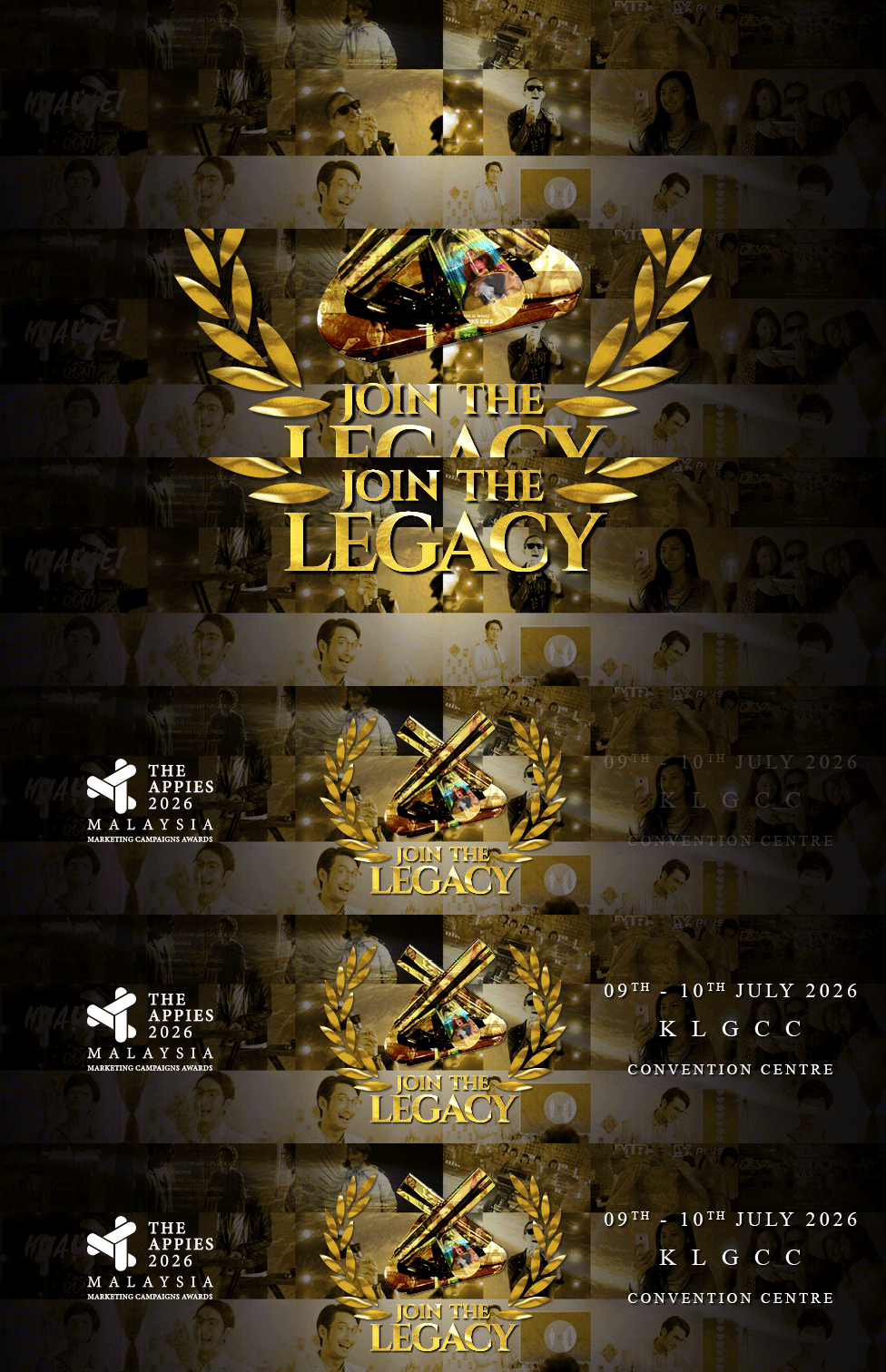

The APPIES is where Malaysia’s boldest campaigns, brightest ideas, and most impactful storytellers take the stage.
More than an awards show, it is the industry’s ultimate platform for creative, media, digital and marketing excellence, where live presentations meet live judging.
This is your chance to showcase work that moved audiences, shaped conversations, and delivered real results.
From breakthrough brand campaigns to innovative digital experiences, the APPIES celebrates the work that defines the future of marketing.
Step into the spotlight alongside the industry’s leading agencies, brands, creatives, strategists and changemakers.
Whether you are aiming for Gold, Silver, Bronze or the prestigious Best of the Best recognition, this is your moment to make history.
Your campaign deserves to be seen.
Your ideas deserve the stage.
Your work deserves the legacy.
KEY DATES
Haven’t subscribed to our Telegram channel yet? Don’t miss out on the hottest updates in marketing & advertising!