Not long ago, propaganda arrived with ceremony. It wore the authority of state television. It carried the weight of print headlines. You knew where it came from, and you knew what it wanted.
Today, it appears between a cooking clip and a football highlight. More often than not, you don’t even register it. Because it no longer looks like propaganda. It looks like content.
From Broadcast to Behaviour
The shift is not technological. It is psychological. Propaganda once depended on repetition. Now it thrives on resonance.
A short-form video does not declare its intent. It borrows the grammar of entertainment such as quick edits, familiar music, emotional cues, and leaves the viewer to connect the dots. It doesn’t instruct. It nudges. And nudges travel much further.
The Facebook clips making the rounds today are not outliers. They are part of a broader evolution where influence is embedded, not announced. Outrage, sympathy, and pride once triggered do the work. The content itself simply lights the match.
The Day Reality Became Editable
A recent investigation by the BBC reveals just how far this has gone.
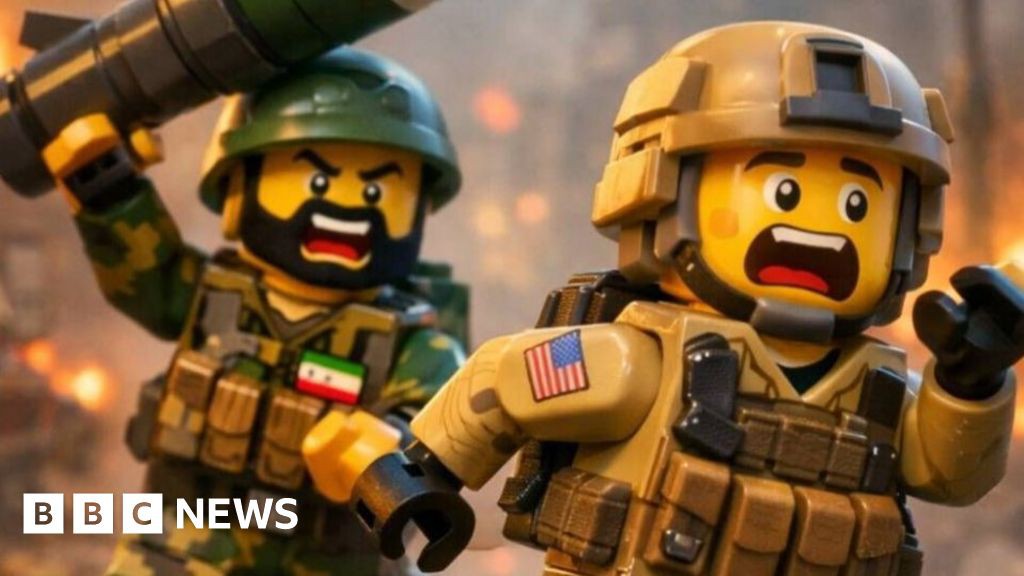
Viral AI-generated videos styled like Lego animations — colourful, fast-paced, almost childlike are being used to depict war, political figures and global conflict. Children appear in danger. Leaders fall through imagined conspiracies. Entire narratives are constructed in seconds.
They are not subtle. But they are effective.
Produced by small teams using generative AI, these clips have been viewed hundreds of millions of times and shared across platforms at extraordinary speed.
What makes them powerful is not just their reach. It is their cultural fluency.
As one creator put it, the Lego-style aesthetic works because it is a “world language.” For the first time, propaganda is not just translated for global audiences. It is designed for them.
The Collapse of Visual Trust
There was a time when seeing was believing. That contract has quietly broken.
AI-generated visuals now sit comfortably alongside real footage in the same feed. A downed fighter jet, a rescued pilot, a battlefield victory — each can be reimagined, reshaped, or entirely fabricated within hours of an event.
In one instance highlighted by the BBC, an AI clip presented an alternative version of a military incident that directly contradicted confirmed reports. Yet it travelled widely, shaping perception before facts could catch up.
Truth, in this environment, is no longer a fixed point. It is a race. And the fastest version often wins.
The Illusion of Consensus
Social media adds another layer: the appearance of agreement. Thousands of shares. Endless comments. A flood of affirmation. It feels real.
But much of it can be orchestrated — amplified by networks, boosted by algorithms, reinforced by repetition. The result is not persuasion in the traditional sense. It is something subtler. A shift in perceived reality.
People rarely change their beliefs overnight. But they do recalibrate what they think others believe. Once something feels widely accepted, it gains a quiet authority of its own. This is propaganda as social proof.
The Meme Replaces the Manifesto
Long speeches are no longer required. A meme will do. A 20-second clip will do even better.
What experts are now calling “memetic warfare” operates in fragments — content designed not to inform, but to circulate. Fast, emotional, endlessly adaptable.
The BBC report describes it as a form of “agile, aggressive internet diplomacy” that bypasses traditional media entirely. No press conferences. No official statements.
Just content, moving at the speed of the scroll. Because it is produced in near real time, it often reaches audiences before any verified account of events.
By the time the truth arrives, the narrative has already taken root.
Why This Should Unsettle Marketers
For brands, this is not someone else’s problem. It is uncomfortably familiar territory.
The same mechanics — storytelling, targeting, cultural cues — sit at the heart of modern marketing. The difference is intent. But from the audience’s perspective, that distinction is becoming harder to see.
Exposure to manipulated content does not just distort politics. It reshapes perception itself.
Audiences begin to question everything. Not loudly. Quietly. A hesitation before belief. When that hesitation sets in, advertising does not escape it. It inherits it.
The Long Game of Believability
In a world where propaganda behaves like content, visibility is no longer the prize. Believability is. And believability cannot be engineered overnight.
It is built slowly. Through consistency. Through actions that align with words. Through a track record that audiences recognise without being told.
Because the real shift is this: Propaganda is no longer trying to convince you. It is trying to feel like something you would choose to watch.
In a feed where everything is designed to feel right, the brands that endure will not be the loudest. They will be the ones that feel unmistakably, consistently true.