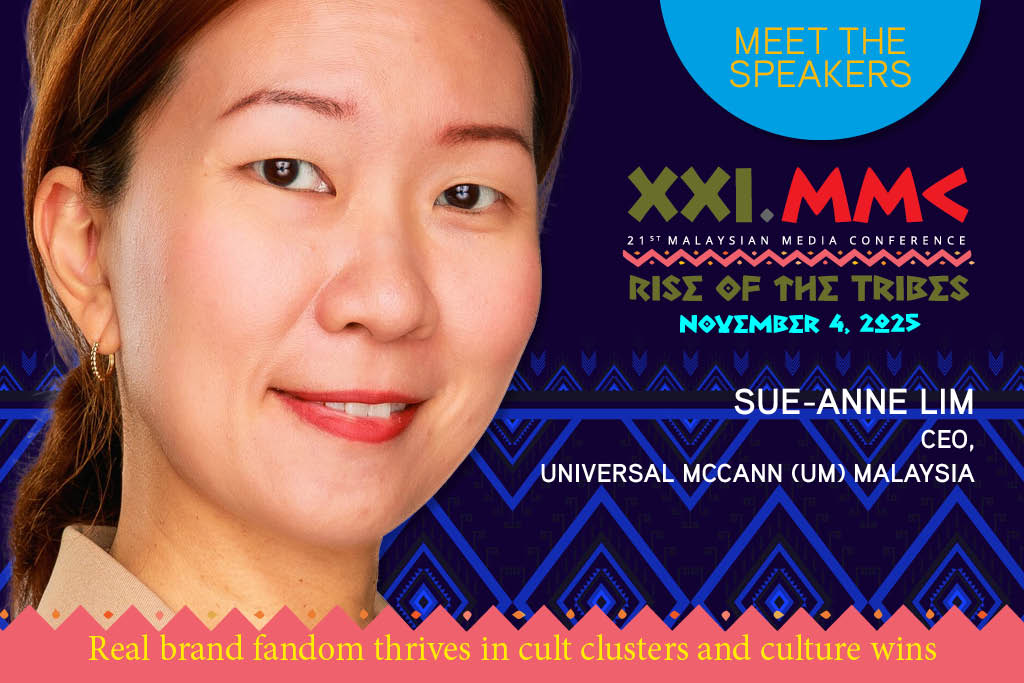
As one of Malaysia’s most forward-thinking agency leaders, Sue-Anne Lim has built a career on reimagining media through a people-first lens. From helping transform the Trapper Group to steering Universal McCann (UM) into a “media plus” consultancy, her philosophy of Heartwork has placed culture and empathy at the centre of strategy.
At the 21st Malaysian Media Conference on November 4, Sue-Anne will kickstart the day with the conference theme The Rise of the Tribes — reframing reach as resonance and showing why, in today’s media landscape, fandom will always beat funnels. We had the opportunity to speak with her ahead of her session.
You talk about “resonance over reach.” Can you recall a time when chasing clicks actually damaged a brand’s equity?
In my career, I’ve seen many instances where a brand slowly eroded itself by starting with a “let’s save money” mindset. First, they switch off brand health tracking which, yes, is costly but crucial. Then they shift budgets wholesale from brand building into performance. Immediately, instant gratification! At first, everyone is happy. Finance can finally see direct ROI, performance dashboards light up, and marketers feel justified.
But then the novelty fades, targets rise, and suddenly leads, sales and even clicks are harder to come by, at a cost that we can’t afford. What’s happening? Unknowingly, the brand is losing its power. Focusing only on clicks commoditises you. Everything your branding predecessors built now teeters on the edge of digital-led sameness.
And because you turned off brand health, you don’t even have a map of which part of the funnel is failing you. At UM, our proprietary 3Vs framework, proven across millions of data points, shows how each channel contributes to each part of the funnel and what ripple effects they create.
For example, in telco, I’ve seen brand equities plunge after two years of click-obsession. Year one is the honeymoon where performance data is delightful, even addictive! But year two onwards, trouble starts. How low can your cost per action go? For a particular client, we’ve been hitting CPVs at an optimised rate of RM0.02. The cost per view is practically free! What is the price of media after ‘free’? And also, can a single video build brand equity?
Even P&G once admitted they were cutting back up to $200m on short-term digital performance in 2018, because it didn’t build growth for them. They realised that they were over invested on clicks that were largely driven by bot traffic and they went back to building what matters – equity. Not entirely! But a better balance of resonance and reach. That’s telling. I’m not saying clicks don’t matter. I’m saying they have a time and place (and a way to do it right).
Also, to all brands out there – growth hacking is great for insurgent brands who are resource-strapped. They have no choice but to spend a considerably large amount of time to outsmart the system. But if you’re an established brand with resources already in place and allocated, I think you should be scaling growth strategically, not trying to save cents at the expense of long-term brand equity.
What’s the most misunderstood thing about cultural tribes that marketers still get wrong?
If we define cultural tribes as communities built around shared resonance, then the biggest misunderstanding is how audiences are segmented. Marketing segments, media segments, and performance segments are all different lenses—and marketers often mix them up.
When I build a brand, I want to reach as many people as possible. The pragmatist says: only reach those who already resonate. The optimist says: why not make more people resonate? I choose the latter. Because how do you grow if you only talk to people who already think like you?
Too many agencies propose campaigns that affirm the brand rather than grow it. If believers aren’t buying, that’s a distribution problem, not advertising. Brand growth is about converting the open-minded, the half-believers. If my brand is about happiness, why only talk to people who are already happy? That’s a self-designed echo chamber. The real job is to design experiences that make the sad a little happier, and the ignorant, aware.
Brand building creates believers. Performance, on the other hand, is pragmatic: get every in-market person to see the utility, whether or not they believe in the brand promise. Both are important. But when building tribes, marketers forget that shared experience is something that transcends echo chambers. Shared experience is what really binds people together.
In building ‘One UM’, how do you keep empathy alive in a data-heavy environment?
No amount of data can replace creativity. And if anyone thinks there’s only one way to read data, they’re already wrong. Insights come from reading data creatively. I find this most useful when layering different data types together—it’s like combining different chemicals; sometimes the reaction creates a whole new light.
At the end of the day, data should be the starting point for empathy, creativity, and service design. That’s why innovation is so important at UM. What we do must be delightful, but also right for the client’s business.
I’ve noticed many clients kept asking for more and more insights from campaigns they’ve run. But let’s be clear: data is just the history of your decisions. If I want a number to go up, I’ll do this. If I want it to go down, I’ll do that. Looking at history alone for insight is odd. The starting point should always be: where do we want to be? Then use the data as a compass on how to get there. That’s strategy planning – the cart should never come before the horse.
If you had to banish one marketing metric forever, which would it be… and why?
I wouldn’t banish any single metric as each has its place and history. What I would banish is the outdated belief that the consumer journey is linear. The AIDA model—attention, interest, desire, action—mirrors a linear funnel, but today’s consumer journey is far more circular, with zigzags across multiple decision points.
That’s why I believe so strongly in UM’s 3Vs. When we run it for clients, millions of unique journeys emerge and it’s impossible to chase one by one. But the model illuminates the strongest growth paths. Those are the ones to invest in until the market shifts again. Linear funnels oversimplify human behaviour. Real marketing has become a lot more messier, thanks to digitalisation.
What’s the bravest cultural insight you’ve acted on that paid off?
Years ago, before the UN’s 17 SDGs even existed, my team researched eco-awareness in Malaysia. We found that a significant number of Malaysians were in the “no action, talk only” group. They cared, but they had no compass: where to find information, how to start, how to act. So we built a campaign that centres on a vision, called Eco-Nation for an electronics client. It was more than a campaign – it was a movement: content, activations, eco-product solutions, a global ambassador, government roundtables. Suddenly, people had a way in. They can get involved.
The result? The brand went from zero to incremental RM2 billion in B2B and B2G revenue. That one banner united consumers, partners, and policymakers. The lesson: don’t only talk to the small pool of people already practicing eco habits. We grew by targeting the half-believers and showing them how to take the first step.
The reason why I chose this example is because this is a campaign that brought in significant business results that stemmed from a simple elegant insight. And this was definitely an equity building campaign because the business results were across 5 years, it wasn’t something that grew overnight and definitely not via clicks!
Fast-forward: which tribes will shock us with their marketing power?
Two groups: the B40s (or B50s, as some economists now call them) and the Silver Generation. B40s have volume. Yet marketers often speak to them in a charitable tone, which is condescending. These are not “value tribes” only—they’re housewives, retirees, Gen Zs, especially Gig Workers (no longer just Blue-collar Workers).
They may be value-driven, but they have aspirations too. Brands like 99 Speedmart, Mixue, and Mr. DIY have understood this and built businesses on accessible aspiration. They also want to be healthy, happy, efficient, effective, etc. Not just cheap.
The Silver Generation is another overlooked tribe. They have spending power, and often their families spend on their behalf. They want convenience, security, experiences, and BIG FONTS. Unfortunately, our government is behind in enabling independent aging—but for marketers, the opportunity is wide open.
Both tribes are undervalued today, but they will surprise us tomorrow.
What are the notable behaviour trends for this category we need to look out for when deciding on media channels?
At the macro level, the big four channels—TV, radio, OOH, digital—are where everyone is. That doesn’t change much. The real differentiation lies in the micro level: which station, which website, which neighbourhood, which social feed. That’s why I don’t make sweeping channel statements.
The question is always: who are we talking to, why, and what outcomes do we want? Only then do we run the data and let it point us to the right micro-channels.
On November 4th, the 21st Malaysian Marketing Conference brings together media strategists, brand leaders, storytellers, and cultural observers to share case studies, fresh data, and lived experiences from the frontlines of tribe-driven marketing. Learn more: https://marketingmagazine.com.my/mmc/2025/
Share Post:
Haven’t subscribed to our Telegram channel yet? Don’t miss out on the hottest updates in marketing & advertising!