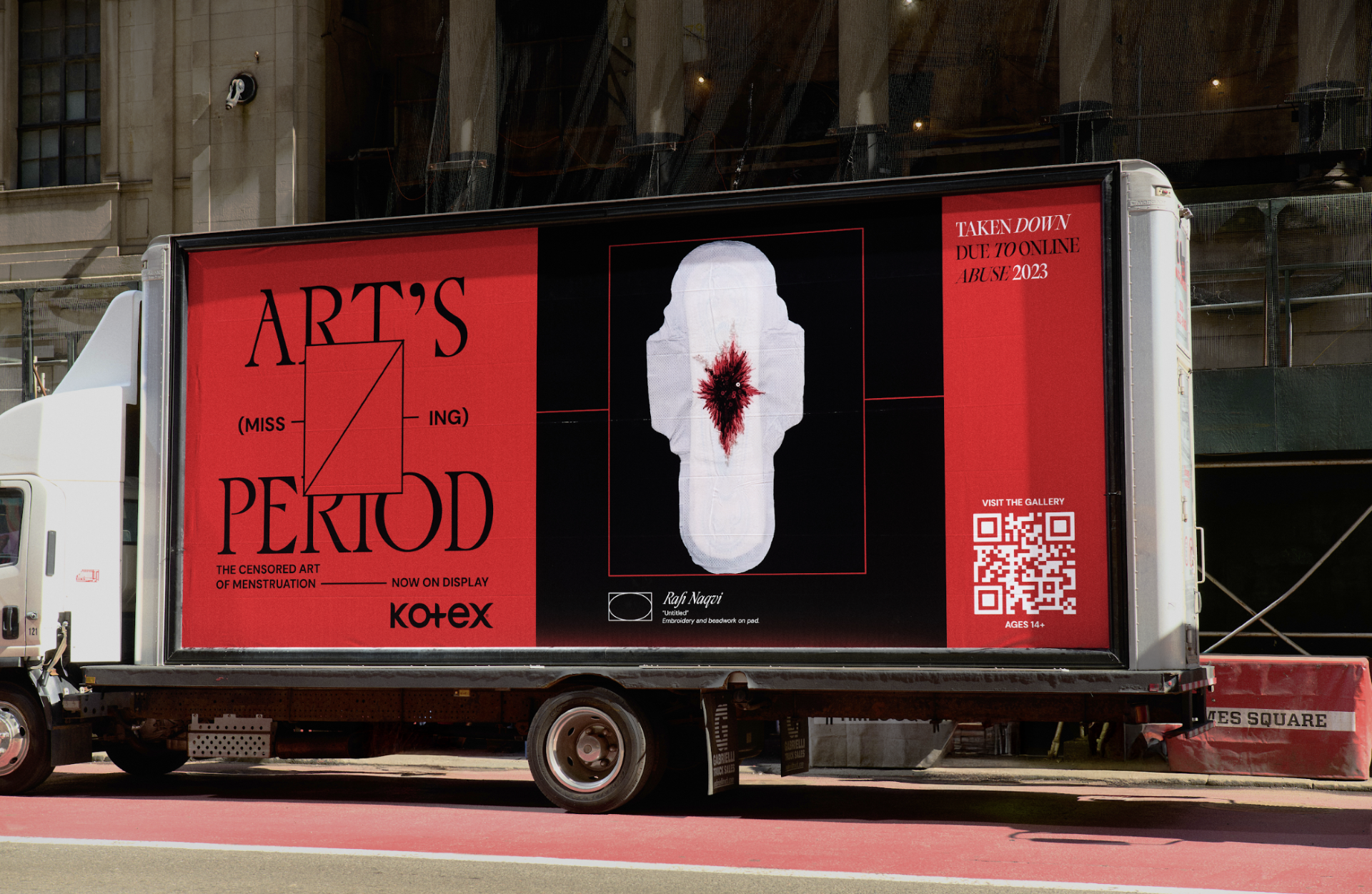
There has never been a shortage of blood in art. It spills across battle scenes, drips from martyrdoms, stains history with drama. The kind that shocks, provokes, even sells postcards in museum gift shops.
But one kind of blood has been quietly airbrushed out of civilisation’s canvas. Not because it is rare, but quite the opposite. Because it is uncomfortable.
Kotex has decided to correct that omission. In doing so, it has landed one of the more quietly defiant campaigns of the year.
The Blood We Chose Not to See
For centuries, art has been generous with violence. From Caravaggio to contemporary installations, blood has been treated as spectacle, symbolism, even beauty. No gallery has ever apologised for it.
Yet period blood, the most ordinary, cyclical, and life-giving kind has been treated as something else entirely. Not art. Not expression. Not even acceptable. Just something to hide.
“Art’s Missing Period,” created with DAVID London and Ogilvy Singapore, doesn’t try to shout this hypocrisy down. It simply holds it up to the light. And lets the silence do the work.
Restoring What Was Removed
The campaign’s premise is deceptively simple. If art has always reflected humanity, then why has it consistently edited out something so fundamentally human? Kotex answers by putting those missing works back into view.
Not newly commissioned pieces alone, but a sweeping collection that stretches back tens of thousands of years including works dating as far as 35,000 BCE alongside contemporary pieces that were rejected, censored, or quietly removed from galleries.
The result is less a campaign and more a curatorial act. A restoration, as the creatives themselves describe it.
It’s a subtle but important shift. This isn’t about inserting a brand into culture. It’s about pointing out where culture has been incomplete all along.
When the Street Becomes the Gallery
Instead of waiting for institutions to change their minds, Kotex takes the work to their doorsteps.
Mobile billboards and wild postings appear outside some of the world’s most recognisable art spaces at the Guggenheim Museum, Metropolitan Museum of Art, Whitney Museum of American Art, and Museum of Modern Art. There is something deliciously subversive about that placement.
Art that was once deemed “too sensitive” now sits just outside the very institutions that helped define what is acceptable to see. Not protesting. Not pleading. Just existing.
QR codes quietly extend the experience into a virtual gallery of over forty pieces, accessible to anyone with a phone for a full year. No velvet ropes. No curatorial gatekeeping. Just visibility.
The Stories Behind the Silence
Running alongside the outdoor work is a short documentary by Kathryn Everett, narrated by Noor Tagouri.
It asks a question that feels almost too obvious once spoken aloud. Why are we comfortable with blood that represents death, but uneasy with blood that represents life?
The film doesn’t try to answer it neatly. Instead, it gives space to artists who have lived the consequences of that discomfort especially whose work was rejected, softened, or simply erased.
In doing so, it reveals that censorship here isn’t loud or dramatic. It is quiet. Systemic. Cultural. Which is precisely why it has lasted so long.
A Brand That Knows Where to Stand
Kotex has played in this territory before, but this feels sharper. More resolved.
There is no attempt to sanitise the message, no metaphor to soften the edges. The brand’s position is clear: periods don’t hold women back. The stigma around them does.
For a category that has historically leaned on euphemism, blue liquids, whispered language, and careful distance, this marks a notable shift in tone.
And a necessary one. Because the real barrier was never biology. It was visibility.
For marketers, the lesson here isn’t simply about bravery or purpose. Those words get thrown around too easily. What Kotex demonstrates is something more precise.
Cultural change rarely comes from adding noise. It comes from identifying what has been deliberately left out and putting it back, without apology.
“Art’s Missing Period” works because it doesn’t invent a conversation. It reveals one that has been avoided for centuries. Once seen, it is difficult to unsee. Which, in the end, is what all good art and all effective marketing should do.
Check out the virtual gallery by Kotex: The Missing Period
Share Post:
Haven’t subscribed to our Telegram channel yet? Don’t miss out on the hottest updates in marketing & advertising!