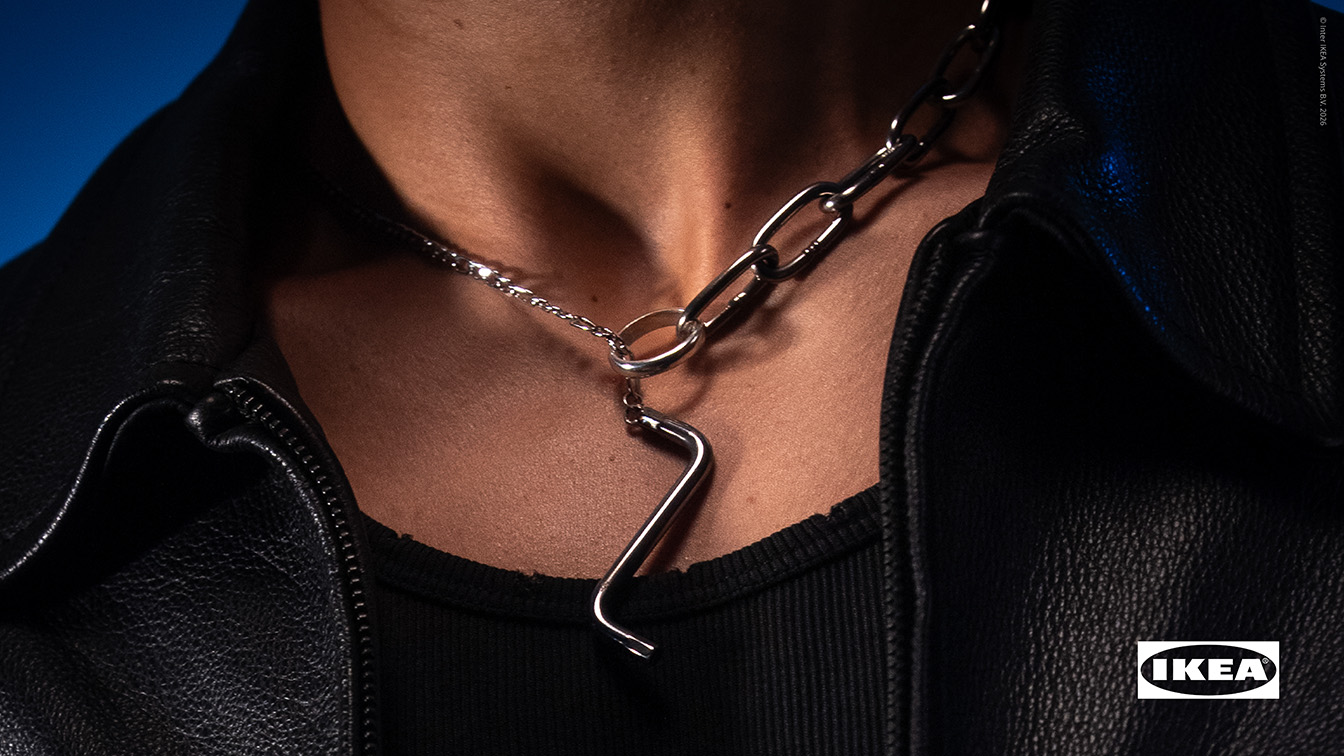
For years, the most reliable thing about an IKEA purchase wasn’t the flatpack. It was the small, L-shaped promise tucked inside. An Allen key that would be used once, then quietly disappear into a drawer of forgotten things. Now, IKEA Singapore has decided that maybe the problem wasn’t the tool. It was how we treated it.
In a collaboration with The Secret Little Agency, the brand has taken that humble piece of metal and given it a second life. Not as a novelty. Not as a gimmick. But as something you can actually wear.
They’re calling it ALLËNKI.
At first glance, it looks like a piece of jewellery. Industrial, stripped back, almost defiant in its simplicity. But the twist is disarmingly honest. It’s still a fully functional Allen key.
Clip it around your neck and you’re not just making a style statement; you’re carrying a tool that can tighten a loose screw on a chair, a shelf, or that wobbling table leg you’ve been meaning to fix.
Turning Utility Into Brand Indentity
What makes this interesting isn’t the object itself. It’s the reframing. The Allen key has always been part of the IKEA experience, but never part of the brand story.
It was an invisible infrastructure, very essential, yet overlooked. By pulling it out of obscurity and placing it front and centre, IKEA is effectively turning a utility into identity.
There’s a quiet confidence in that move. No over-engineering. No attempt to dress it up as something it isn’t. Just a simple idea. What if the thing you always lose became the thing you always keep on you?
In doing so, the brand taps neatly into a broader cultural shift. Practicality is having a moment. Objects that really do something, and carry more weight than those that simply look good.
ALLËNKI sits right in that space, where function meets form without apology.
Design That’s Straightforward
The design language leans into rawness. It doesn’t try to disguise the Allen key as fine jewellery. Instead, it celebrates its geometry, its purpose, its familiarity.
That honesty matters. Because consumers today are quick to spot when brands try too hard. Here, the idea is almost disarmingly straightforward: take something real, keep it real, and let people decide what it means to them.
It also reflects a growing fascination with everyday objects being recontextualised. Think of it as the opposite of luxury. Not about adding value through embellishment, but revealing value that was already there.
A Conversation Starter That Works
Whether ALLËNKI ever makes it to retail shelves is beside the point.
The real win is how it reframes IKEA itself. Not just as a furniture retailer, but as a brand that understands the small rituals around its products—the assembling, the adjusting, the living with them.
More importantly, it shows a willingness to play with its own icons. Because the Allen key, in its own quiet way, is as recognisable as any IKEA product.
By turning it into something wearable, IKEA isn’t just creating a talking point. It’s reminding people that even the most overlooked parts of a brand can carry meaning if you’re willing to look at them differently.
Sometimes, the smartest ideas aren’t about inventing something new. They’re about seeing what’s already in your hand, and realising it might belong somewhere else entirely.
Share Post:
Haven’t subscribed to our Telegram channel yet? Don’t miss out on the hottest updates in marketing & advertising!