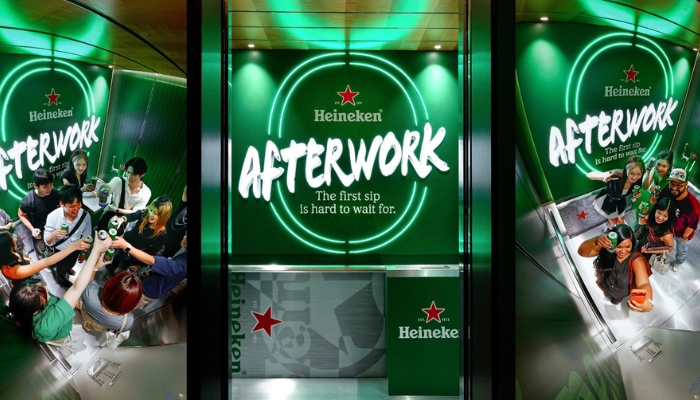
There’s a familiar ritual across Asia’s financial districts. The laptop shuts. The shoulders drop. The lift doors open. Somewhere between the 28th floor and the lobby, the day begins to loosen its grip.
In Singapore, Heineken decided that this in-between moment wasn’t just dead space. It was prime real estate. So they did something quietly subversive. They turned an office elevator into a bar.
Where The Workday Actually Ends
On 1 April, at One Raffles Quay, the brand staged a tightly orchestrated intervention that caught 384 office workers mid-transition. At 5:30pm — not quite office hours, not quite after-hours — commuters stepping into a routine lift ride were instead handed a cold beer.
Inside the lift, Singapore-based livestreamer Denise Teo played bartender, offering cans of Heineken as the doors slid open floor by floor.
It wasn’t loud. It wasn’t branded to death. It was simply unexpected. And that was the point. One office worker described the shift instantly from post-meeting fatigue to spontaneous camaraderie.
Strangers who would typically stare at their phones began clinking cans. A shared pause, engineered in a space designed to move quickly and say nothing.
The Rise Of The “In-Between” Economy
What Heineken is really targeting here isn’t just afterwork drinks. It’s the psychological pivot point:the moment when people mentally clock out, even if they haven’t physically left the building.
Most brands wait for consumers to arrive at bars, restaurants, or retail spaces. Heineken is intercepting them earlier, at the exact point where mood, openness and social energy begin to shift.
It’s a subtle but important reframing. Instead of asking, “Where do people drink?” the campaign asks, “When do people become ready to drink?”
That distinction matters in dense urban environments like Singapore, where time is compressed and routines are tightly structured.
The lift often overlooked becomes a surprisingly intimate setting. You’re captive, briefly. You’re between identities: employee on one floor, individual on the next.
Heineken simply inserted itself into that transition
Small Space, Big Signal
From a media standpoint, this is not a scale play. 384 people is a rounding error in campaign metrics. But that misses the strategy.
This is engineered for amplification. A contained, hyper-specific experience designed to travel far beyond the lift via social sharing, word-of-mouth and earned media.
The presence of a livestreamer signals this clearly. The real audience isn’t just inside the elevator, it’s outside it. And importantly, the idea is portable.
If a lift can become a bar, so can a lobby, a car park, or a train platform. The campaign opens up a modular approach to activation one that doesn’t rely on traditional venues but instead hijacks transitional spaces.
A Brand Leaning Into Spontaneity
For Heineken, this builds on a long-standing positioning around “quality socialising.” But here, the tone is less orchestrated nightlife and more everyday spontaneity.
Gemma Goh, Marketing Manager at Heineken Singapore, frames it as a reminder that social connection doesn’t need elaborate planning. The first drink of the evening — often the most anticipated — might be closer than expected.
That’s a clever reframing of product value. The beer isn’t just refreshment. It’s a trigger. A signal that the day has ended.
From Stunt To System
The lift activation is only the opening move. The campaign will extend into a larger experiential platform, including “The First Sip House,” a pop-up running from 7 to 16 May, bookable via Klook.
If the lift was about surprise, the pop-up will likely focus on repeatable engagement turning a fleeting moment into a more structured brand experience. Together, they form a two-step strategy: disrupt, then deepen.
In a region where work-life boundaries are increasingly blurred, brands that understand micro-moments not just macro-occasions are gaining an edge.
The elevator stunt works because it respects the audience’s reality. It doesn’t ask for extra time, extra effort, or a change in behaviour. It simply enhances a moment that already exists.
In doing so, it quietly answers a bigger question facing marketers today:
Not how do we get attention?
But where are people already open to it?
Somewhere between floors, it turns out, is a very good place to start.
Share Post:
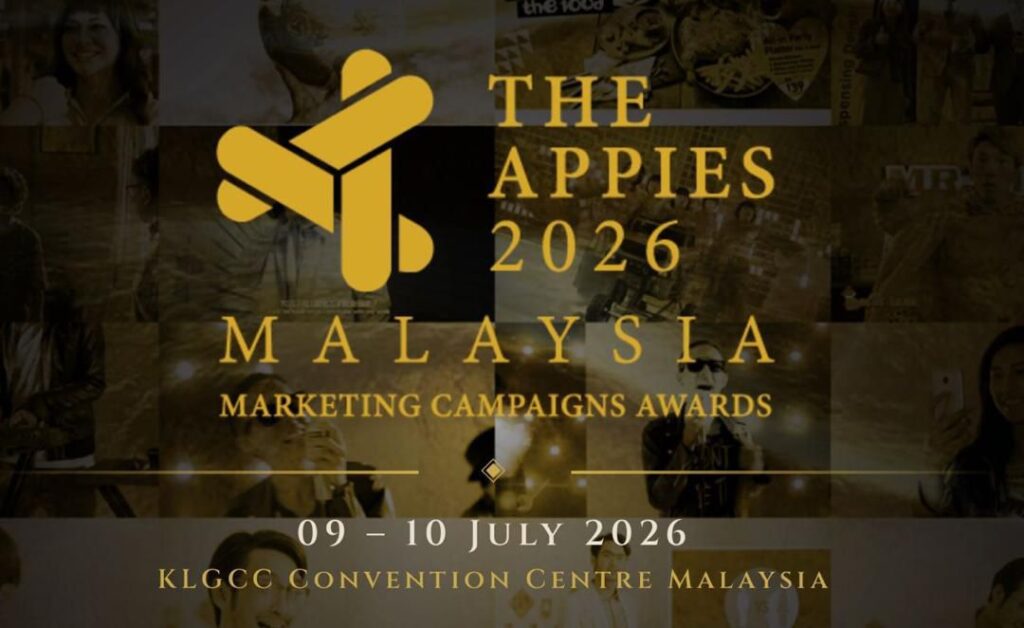
The APPIES is where Malaysia’s boldest campaigns, brightest ideas, and most impactful storytellers take the stage.
More than an awards show, it is the industry’s ultimate platform for creative, media, digital and marketing excellence, where live presentations meet live judging.
This is your chance to showcase work that moved audiences, shaped conversations, and delivered real results.
From breakthrough brand campaigns to innovative digital experiences, the APPIES celebrates the work that defines the future of marketing.
Step into the spotlight alongside the industry’s leading agencies, brands, creatives, strategists and changemakers.
Whether you are aiming for Gold, Silver, Bronze or the prestigious Best of the Best recognition, this is your moment to make history.
Your campaign deserves to be seen.
Your ideas deserve the stage.
Your work deserves the legacy.
KEY DATES
Haven’t subscribed to our Telegram channel yet? Don’t miss out on the hottest updates in marketing & advertising!