When Cathay Cargo and Leo Burnett Hong Kong set out to reimagine the transport of animals by air, they weren’t expecting to make one of the world’s first fully AI-native commercials at this scale. But they did. And not only did it work—it raised the bar.
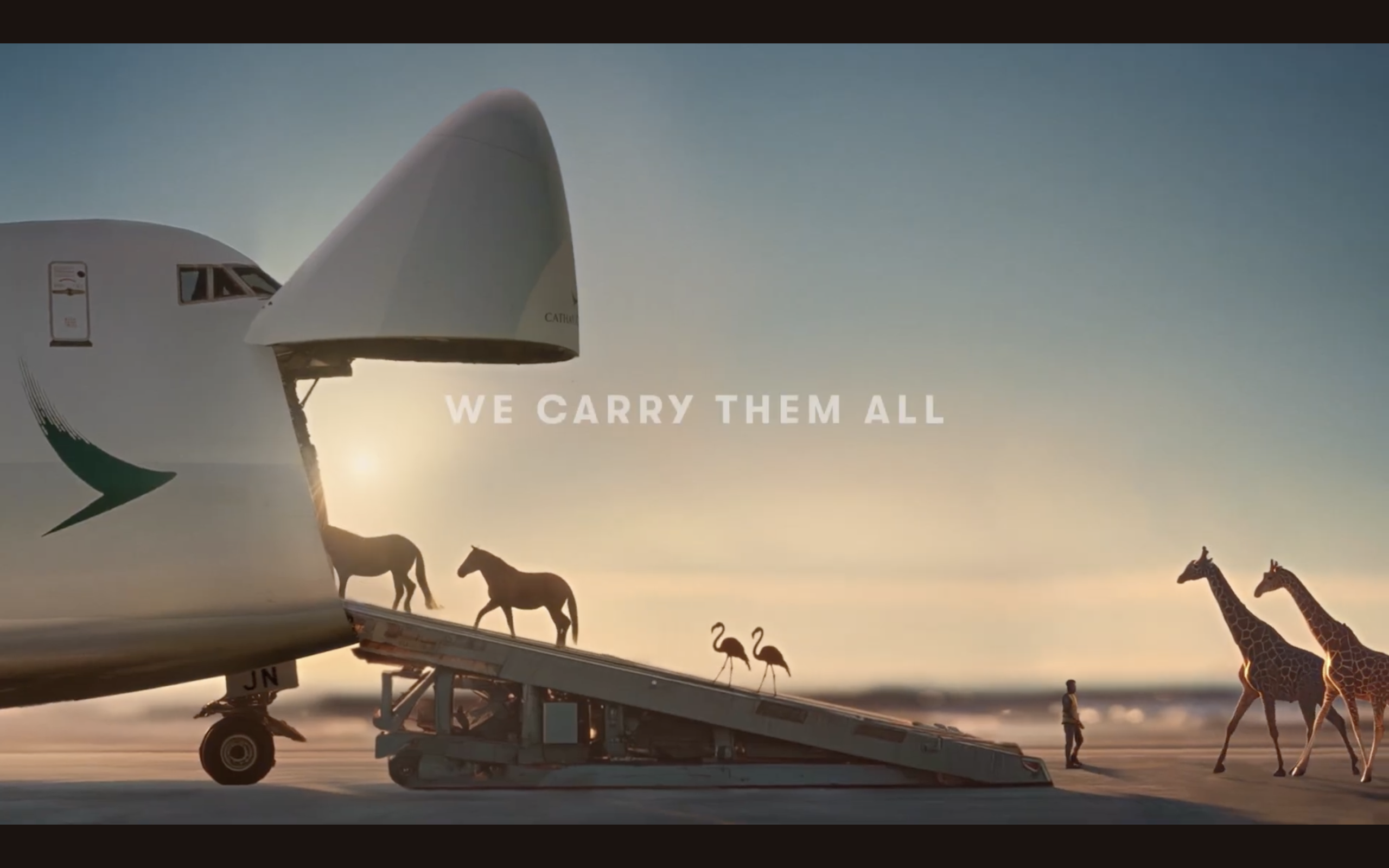
The result is “Welcome All, Big and Small”, a visually rich, emotionally grounded film that sees giraffes, sloths, parrots, and alpacas boarding a Cathay Cargo aircraft with the kind of poise you’d expect from first-class travelers. What’s missing? A physical set. A single animal. Even a single day of traditional shooting. What remains? Craft, vision, and a whole lot of humanity.
The Shoot That Never Happened
It all started like any other commercial: a brief with heart, a strong concept, and a big logistical challenge. The original vision—a modern-day Ark filled with animals of all sizes calmly boarding a Cathay Cargo freighter—meant coordinating trainers, animal wranglers, permits, and a grueling five-day live shoot.
“It would’ve made Noah sweat,” laughs Charlie Chen, Executive Producer at Lucky Sparks.
But time and complexity forced a rethink. That’s when Executive Producer Jimmy Singh (LiQuid Production) suggested something radical: “What if we don’t shoot it at all?”
That leap of faith changed everything.
Enter AI
Jimmy brought in Christopher Vulpi, founder of AGENT*EP and a creative executive with deep roots in CGI, VFX, and now AI-native storytelling. Vulpi didn’t just consult—he rebuilt the approach from the ground up, assembling a hybrid team of AI artists, designers, and postproduction veterans.
As AI Creative Executive Producer, Vulpi brought on longtime collaborator Brent Bonacorso to direct. With a background in design, VFX, and five AI-native campaigns under his belt, Bonacorso was uniquely suited to a job that required no camera—but plenty of emotional direction.
“Directing with AI is a whole new genre,” says Bonacorso. “It’s more like sculpting with mood and rhythm. When you guide it right, the system creates these surreal, beautiful moments that feel oddly real.”

The Process
Instead of sets and cameras, the team built a full AI-native workflow. Visual ideation, image generation, and animation development were all handled through custom prompt modeling, paired with industry-standard post tools like Flame, Davinci Resolve, and Nuke.
In short: it was high-end production, just with different inputs.
“The tools were new,” Vulpi notes, “but the discipline wasn’t. We approached this like any cinematic job. Just because AI accelerates iteration doesn’t mean you skip the craft. Brand tone, emotional clarity, and story flow still take time.”
Working across four time zones, LiQuid and Lucky Sparks managed feedback loops with Leo Burnett Hong Kong. Jimmy Singh and Daniel Agus Susanto led the flow of operations with calm precision, while Charlie Chen and Banana Lin anchored the producer front—fielding late-night agency notes and keeping momentum alive.
“We had to think like artists, write like animators, and negotiate with robots,” says Jimmy. “It was like building the plane midair—and finding out it could fly.”
When Sound Made It Sing
Once the visuals locked, the film needed soul. Enter Two AM Music.
Prisca Leong’s original score gave the AI-rendered world its emotional anchor, while Jason Lee’s detailed sound mix brought the characters to life—slow-motion sloths and all. Under the guidance of Oliver Stutz and Kit Kuan Leong, and with supervision by Adrienne Yong, the result was unexpectedly cinematic.
“It’s wild how much music grounded the film,” Bonacorso says. “Suddenly, that sloth wasn’t just slow—he had purpose.”
This wasn’t a tech demo. It was a full-scale brand film—creatively led, emotionally resonant, and globally delivered without ever calling “Action.”
“It wasn’t just an AI play,” Vulpi explains. “It was about crafting something real from a new process. The technology didn’t replace anyone—it expanded what was possible.”
For Leo Burnett, Cathay Cargo, and the teams at LiQuid and Lucky Sparks, this wasn’t just a workaround—it was a revelation. Proof that with the right team, trust, and tools, AI-native production can meet the highest creative standards.
“What we made wasn’t just a campaign,” says Jimmy Singh. “It was proof that the future of production isn’t about choosing between technology and creativity—it’s about combining them.”
Edward Bell, General Manager, Brand, Insights and Marketing Communications at Cathay. says, “In this video, we aim to narrate the utmost care we provide in Cathay Live Animal solutions, connecting the importance of compassion with the beauty of these creatures. Whether welcoming a show horse, an endangered species, or a cherished pet, we pride ourselves on treating our guests not as mere shipments, but as living beings with heartbeats deserving of tailored, professional care as we help move them around the world.”
João Braga, Global Executive Creative Director at Publicis Groupe Hong Kong, adds, “Cathay Cargo not only has the expertise in transporting all kinds of animals, they genuinely care for each species on their watch. So when we landed on the idea of a modern-day ark, we saw an opportunity to be truly intentional with the use of tech. If we can use AI to avoid putting animals through the stress of a taxing shoot, then why wouldn’t we?”
Client: Cathay Cargo
Creative Agency: Leo Hong Kong
Production|Co-Production | LiQuid & Lucky Sparks
Executive Producers|Jimmy Singh, Danile Agus Susanto, Charlie Chen & Banana Lin
AI Creative Executive Producer | Christopher Vulpi (Agent EP)
Film Director, AI core story prompt, Edit | Brent Bonacorso
Line Producer|Marlyne Vanessa
Music & Sound Design|Two AM Music