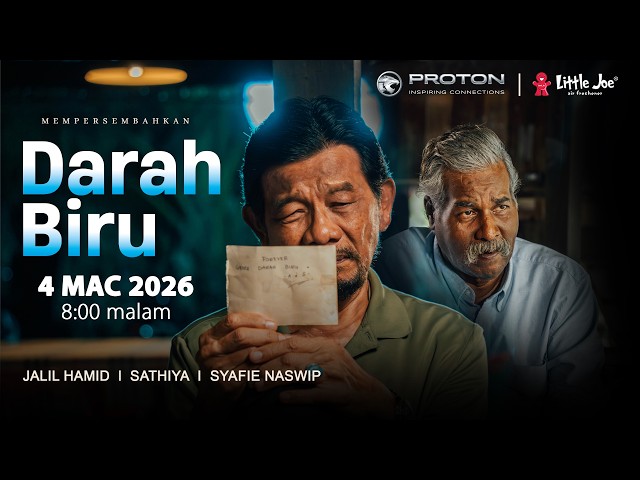
Every Raya season in Malaysia brings a familiar parade of festive short films. Families reunite. Tears flow. Forgiveness arrives just in time for ketupat and rendang. But “Darah Biru”, the new Raya film by Proton in collaboration with air-freshener brand Little Joe, takes a different route. Instead of beginning in a kampung or a living room, it starts in a factory.
And not just any factory — the once-iconic Proton Shah Alam Plant, a place that helped shape Malaysia’s industrial identity. The result is a Raya story that feels less like advertising and more like a love letter to an era when Malaysia was learning to build its own future.
A Story of Friendship Forged on the Factory Floor
At the centre of “Darah Biru” are Akib and Surya, two young engineers who begin their careers at Proton’s Shah Alam plant. They share the same dream: to build something meaningful for the country.
The film captures that youthful optimism beautifully — the excitement of being part of a national project, the quiet pride of wearing the Proton badge, and the everyday camaraderie of colleagues who slowly become family. But like many friendships forged in youth, theirs eventually fractures.
A misunderstanding grows into distance. Pride replaces conversation. The two men drift apart. And just like that, decades of friendship dissolve. The emotional pivot of the film happens years later when Akib, now older and reflective, recounts the story to his son.
Curious about the unresolved past, the son sets out on a mission: to find Surya and mend what time never healed. It is a simple narrative device, but an effective one. Because sometimes reconciliation needs a new generation to begin.
The Factory That Built More Than Cars
What elevates “Darah Biru” beyond a typical Raya ad is its setting. The Proton Shah Alam plant, which closed in 2024 after nearly four decades of operation, is not just a backdrop. It is a character in the story.
For Malaysians who grew up during the 1980s and 1990s, Proton symbolised something bigger than automobiles. It represented national ambition.
It was where Malaysia attempted something audacious: building its own car industry. In that context, the title “Darah Biru” (Blue Blood) becomes particularly resonant.
It speaks not only to loyalty between friends, but also to the pride many Malaysians once felt toward Proton — a brand intertwined with the country’s industrialisation story.
The film subtly taps into that nostalgia. The clang of machinery, the rows of vehicles on the production line, the quiet dignity of factory workers — all evoke a period when Shah Alam was one of the beating hearts of Malaysian manufacturing.
Pekin Ibrahim’s Quietly Powerful Direction
The film is directed by Pekin Ibrahim, who approaches the narrative with restraint rather than melodrama. There are no exaggerated emotional cues or forced plot twists.
Instead, Pekin leans into silence, lingering glances, and understated performances — allowing the story’s emotional weight to build gradually. The casting helps anchor the film in authenticity.
Veteran actors Jalil Hamid and Sathiya bring gravitas to the older characters, while younger talents like Syafie Naswip and Akmal Ahmad capture the hopeful energy of the engineers’ early years. Together, they create a believable emotional arc that spans decades.
Nostalgia as Brand Storytelling
From a marketing perspective, “Darah Biru” demonstrates how brands can tap into national memory without sounding like a history lesson.
Rather than promoting vehicles directly, Proton positions itself within the broader narrative of Malaysia’s development. It reminds audiences that Proton was never just about transportation. It was about identity, aspiration, and the belief that Malaysia could build something of its own.
For Little Joe, the collaboration is equally interesting. Air fresheners rarely get the spotlight in storytelling-driven campaigns.
Yet by partnering with Proton and embedding the product subtly within the narrative world of cars and journeys, the brand gains cultural relevance without overt product placement.
A Raya Story That Feels Uniquely Malaysian
Perhaps the most powerful aspect of “Darah Biru” is how naturally it reflects Malaysia’s multicultural reality.
Akib and Surya come from different ethnic backgrounds, yet their friendship feels completely ordinary. There is no heavy-handed messaging about unity.
Instead, the film simply shows what Malaysians already know: friendships often cut across race, language, and religion. In that sense, the story quietly echoes the spirit of Raya itself — forgiveness, reconciliation, and the rediscovery of relationships that matter.
A Film About Repairing More Than Friendship
By the time the film reaches its emotional resolution, the story has subtly shifted from nostalgia to healing. It becomes about repairing broken bonds. Between friends. Between generations.
And perhaps even between Malaysians and the memories tied to places like the Shah Alam factory. In an advertising landscape crowded with festive sentimentality, “Darah Biru” stands out for its quiet sincerity.
It reminds us that sometimes the most powerful stories are not about selling a product. They are about honouring the journeys that shaped a nation.
Share Post:



The APPIES is where Malaysia’s boldest campaigns, brightest ideas, and most impactful storytellers take the stage.
More than an awards show, it is the industry’s ultimate platform for creative, media, digital and marketing excellence, where live presentations meet live judging.
This is your chance to showcase work that moved audiences, shaped conversations, and delivered real results.
From breakthrough brand campaigns to innovative digital experiences, the APPIES celebrates the work that defines the future of marketing.
Step into the spotlight alongside the industry’s leading agencies, brands, creatives, strategists and changemakers.
Whether you are aiming for Gold, Silver, Bronze or the prestigious Best of the Best recognition, this is your moment to make history.
Your campaign deserves to be seen.
Your ideas deserve the stage.
Your work deserves the legacy.
KEY DATES
Haven’t subscribed to our Telegram channel yet? Don’t miss out on the hottest updates in marketing & advertising!