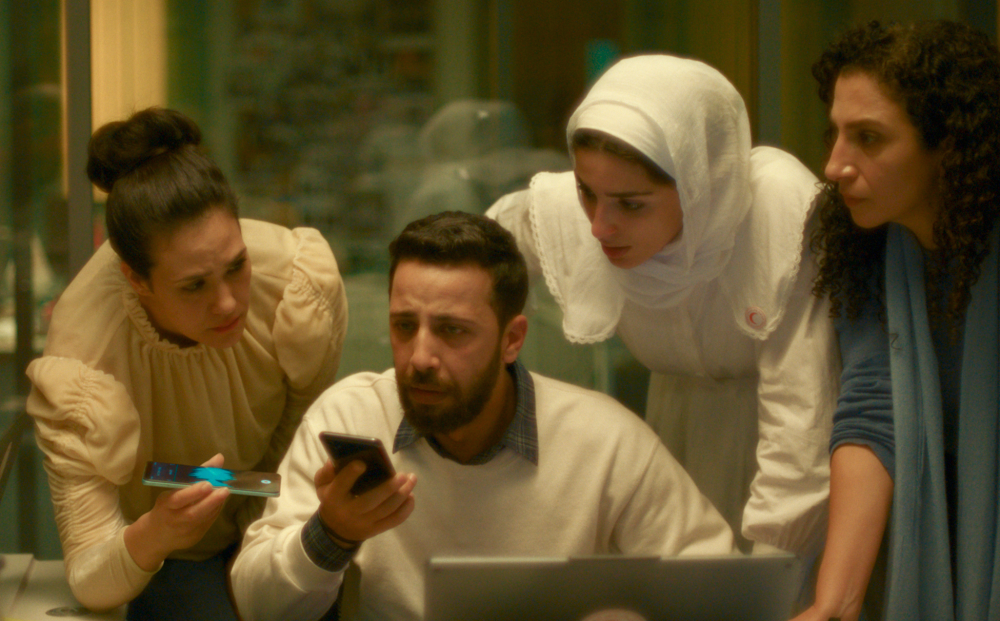
In an era where marketing dashboards glow brighter than human faces, The Voice of Hind Rajab arrives as a quiet but devastating reminder: attention is not the same as impact.
Kaouther Ben Hania’s film has swept international festivals, racked up audience awards, and positioned itself as Tunisia’s official entry for the 2026 Academy Awards.
But its true achievement lies elsewhere. It has done what very few pieces of modern content manage to do — it has stopped people mid-scroll, mid-rationalisation, mid-comfort.
Constructed from real emergency call recordings and anchored by the actual voice of a young Palestinian girl, the film refuses polish, spectacle or narrative shortcuts.
There is no musical manipulation, no editorial cushioning.
Just presence. Just truth.
And that is precisely why it has resonated.
Proof That Authenticity Still Wins
In marketing, we often talk about “authenticity” as a strategy.
The Voice of Hind Rajab reminds us that authenticity is not a tactic — it is a risk.
The film’s record-breaking 9.52 audience score at San Sebastián, its multiple Audience Awards across Europe, and its screening at the United Nations all point to a deeper truth: when audiences sense honesty, they respond — viscerally, emotionally, and collectively.
This is not content engineered for virality. There is no algorithmic hook, no meme-friendly framing.
Yet the film has travelled across cultures, languages and political fault lines because it speaks to something marketing too often forgets — shared humanity.
For brands and agencies, the lesson is uncomfortable but essential: impact is not manufactured through optimisation alone.
From Storytelling to Moral Presence
What elevates The Voice of Hind Rajab beyond cinema — and into relevance for marketers — is its moral clarity.
The film does not ask viewers what they think.
It asks them whether they are willing to listen.
In a world where brands increasingly position themselves as values-led, purpose-driven and socially conscious, this film exposes the gap between saying something and standing for something.
It demonstrates that storytelling with consequence demands restraint, courage, and a willingness to let silence do the work.
This is why its accolades feel secondary.
Awards did not make the film powerful. The film forced awards bodies, audiences, and institutions to respond.

Attention Is Easy. Memory Is Hard.
Marketing has mastered attention. But memory — the kind that lingers, unsettles, and reshapes perspective — remains elusive.
The Voice of Hind Rajab lingers because it does not resolve neatly. There is no redemption arc, no comforting takeaway.
Instead, it leaves viewers with a question that marketing professionals should sit with carefully: What stories are we choosing not to tell because they are inconvenient, uncomfortable, or unprofitable?
In a content economy addicted to speed, this film moves slowly. In a landscape obsessed with positivity, it insists on truth. In a business that measures success in impressions, it measures success in silence — the kind that falls over a room when people realise they have truly heard something.
The Voice of Hind Rajab is not just a cultural milestone. It is a recalibration.
It reminds us that storytelling is not about amplification alone — it is about responsibility.
That the most powerful narratives are not always the loudest.
And that sometimes, the bravest creative decision is to step back and let a single human voice carry the weight.
As the film opens in selected Malaysian cinemas on 8 January, it offers more than a cinematic experience.
It offers a benchmark — for filmmakers, for brands, and for anyone who believes communication should still mean something.
Because long after the campaigns end and the dashboards refresh, the stories that endure are the ones that dared to listen first.