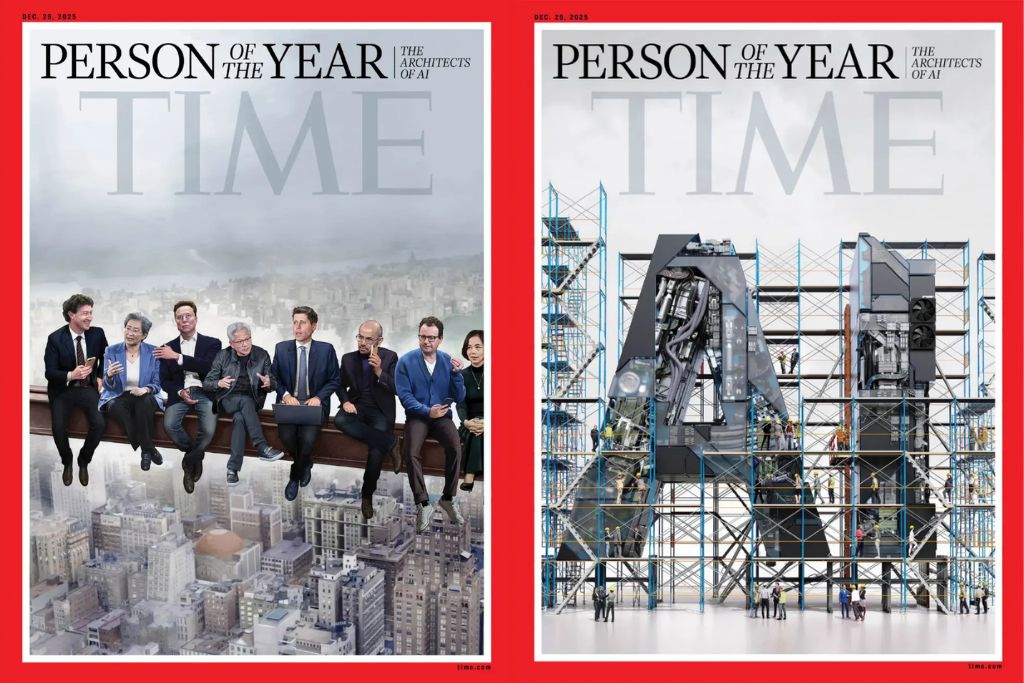
When Time Magazine named its 2025 Person of the Year, it didn’t point to a celebrity, a global leader, or a singular changemaker.
Instead, it chose a collective: “the architects” of artificial intelligence.
And in doing so, it signalled something bigger than a media accolade — it recognised that AI is no longer a tool shaping industries; it is shaping civilisation itself.
The two Time covers released tell the story visually and symbolically.
One depicts AI as a towering monolith under construction, surrounded by workers; the other replaces the ironworkers in the iconic “Lunch atop a Skyscraper” photograph with Jensen Huang, Mark Zuckerberg, Elon Musk, Fei-Fei Li, Sam Altman, Lisa Su, Sir Demis Hassabis, and Dario Amodei.
These aren’t just faces of influence.
They are the individuals steering the fastest industrial acceleration since the advent of the internet — only this time, the feedback loop is exponential.
Time’s framing is blunt: humanity is now “flying down the highway, all gas no brakes, toward a highly automated and highly uncertain future.”
The debate over how to regulate AI has been overtaken by a race to deploy it.
And for marketers — an industry that thrives on mastering complexity — this is the moment where clarity of intent matters more than novelty of tools.
AI Has Become Invisible — And That’s the Real Story
For a decade, AI hovered in the background of marketing conversations as something adjacent: programmatic media, recommendation engines, predictive analytics. Useful, yes, but hardly revolutionary.
But 2025 is different. As Forrester’s Thomas Husson notes, AI’s adoption is now “much faster than during the Internet or mobile revolutions” because consumers are using it without even realising it.
Holiday planning, gift discovery, recipes, financial decisions, content creation — many consumers now default to chatbots instead of search engines.
The interface is no longer the website or app, but the conversation.
For marketers, this shift rewrites traditional funnel thinking. Discovery, evaluation, and recommendation behaviour now sit in a single interaction with a generative model.
In other words: if your brand is not present, structured, and “understood” by AI systems, you may not show up at all.
That is a different kind of brand invisibility — not one caused by poor media planning, but by algorithmic omission.
The Titans Behind the Curtain
The individuals Time chose are not merely running companies; they are setting the technical, ethical, and economic parameters for the next decade.
These are not just boardroom choices. They have downstream consequences for creative expression, audience targeting, privacy policy, and even consumer expectations of authenticity.
As Time’s editor-in-chief puts it, “no one” had more influence in 2025 than those who “imagined, designed, and built AI.”
For marketers, this means the platforms you rely on are not just evolving — they are mutating.
Brand teams must build competencies that are part technical literacy, part foresight, and part cultural understanding.
The Consumer Paradox: Acceleration and Avoidance
One fascinating tension highlighted in the report is the split in consumer psychology.
Millions are embracing AI wholeheartedly — using it to generate ideas, automate tasks, co-create content, or simply reduce decision fatigue.
Yet a growing number are opting out entirely. Concerns over energy use, data extraction, intellectual property, and job displacement are creating a counterculture of “digital minimalists.”
This divergence matters. The next wave of marketing segmentation will not simply be demographic or behavioural; it will be attitudinal.
Brands will need to speak differently to:
Ignoring this attitudinal divide risks alienating a significant portion of Malaysian consumers who are wary of being swept up in the automation tide.
From Hype to Responsibility: A New Strategic Imperative
Nik Kairinos of Fountech AI cautions that recognition should not be mistaken for readiness. Though AI’s trajectory is impressive, we are “still in the early stages” of building systems that are “dependable, accountable, and aligned with human values.”
For marketers, this is where responsibility becomes strategy.
The industry cannot adopt AI blindly — not when automation can distort representation, perpetuate bias, or replace human storytellers.
Creativity is not merely output; it is intention, context, nuance, and cultural resonance. Machines can support this, but not substitute it.
2026 will demand:
The brands that get ahead will be those that treat AI not as a shortcut, but as a capability — something integrated, governed, and continuously questioned.
A Future Still Under Construction
The Time cover showing workers building the giant “AI” structure is more accurate than the magazine may realise. We are still at the scaffolding stage of this new era.
Like any construction project, what gets built — and whether it stands — will depend on the intentions, discipline, and long-term vision of those assembling it.
For marketers, this is the moment to move from passive observers to active architects.
The tools are powerful. The risks are real. The future is unwritten.
But if 2025 taught us anything, it is this: the age of AI is not something arriving tomorrow.
It is already shaping how every Malaysian brand will think, behave, communicate, and compete today.
Share Post:
Haven’t subscribed to our Telegram channel yet? Don’t miss out on the hottest updates in marketing & advertising!