Advertising once taught us how to sell soap.
Now it is learning how to move souls.
Across Malaysia, something unusual is happening.
Humanitarian organisations — traditionally modest, procedural, quietly operational — are beginning to communicate with the strategic sharpness of global brands.
Not louder. Not flashier. Just clearer, smarter, and far more emotionally precise. And in doing so, they are quietly rewriting the rules of purpose-driven communication.
Few examples illustrate this shift better than MAPIM Malaysia and its recent mobilisation around the Sumud humanitarian missions, where communication did not follow the work. It was part of the work.
Because in the modern attention economy, silence is invisibility.
Not CSR. Not Publicity. Participation.
Corporate social responsibility used to behave like a polite guest at the strategy table — welcomed, acknowledged, and then gently placed in the corner while the real business conversation continued.
Today, audiences expect something far less ceremonial and far more authentic.
They want participation. They want transparency. They want proof that purpose is not written only in annual reports.
MAPIM’s communications strategy understands this instinctively.
Instead of presenting humanitarian missions as completed stories — neat, edited, retrospective — the organisation invites the public into the unfolding narrative itself.
Missions are tracked. Updates are shared. Field realities are shown without theatrical polish. Compassion becomes visible in motion.
And visibility changes everything.
Trust Moves at the Speed of Transparency
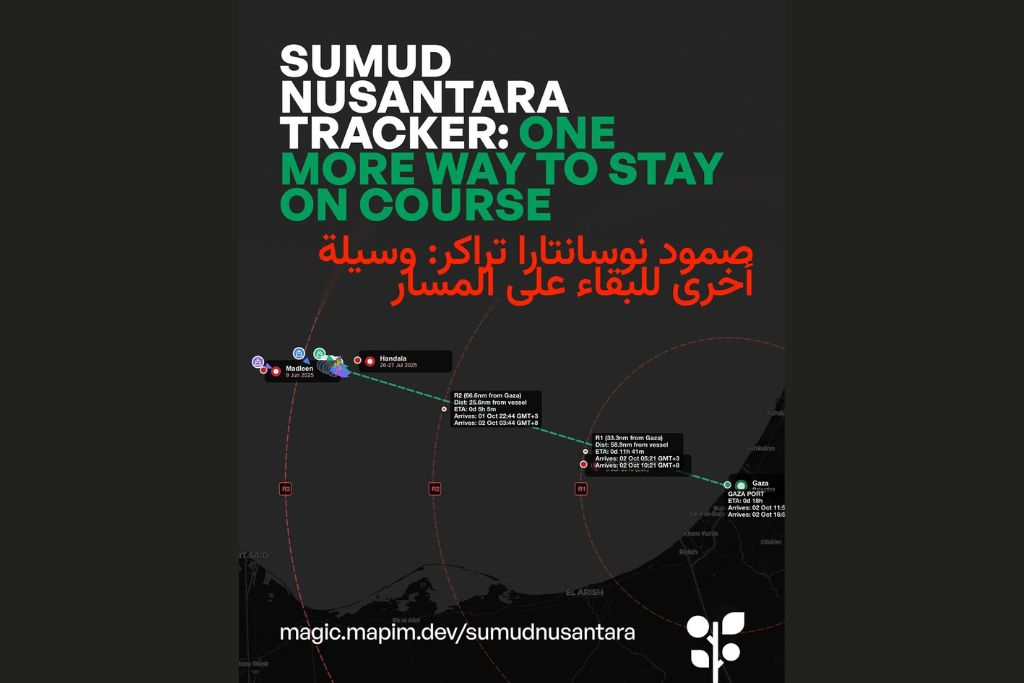
One of the most instructive innovations for marketers is the Sumud Nusantara Tracker, a public-facing platform that allowed Malaysians to follow humanitarian vessels and Malaysian participants in real time.
It was not a campaign stunt. It was operational transparency, digitised.
When flotilla vessels encountered uncertainty, Malaysians did not read next-day headlines; they followed developments as they happened.
Families watched. Communities shared updates. Social conversations multiplied organically. Millions were not observers.
They were emotionally invested travellers on the same journey.
Marketing departments spend millions trying to create engagement. Sometimes engagement simply requires opening the curtains.

When Brands Join, Belief Scales
Another quiet revolution is taking place in how corporations participate in humanitarian initiatives.
Increasingly, companies are not being positioned merely as sponsors writing cheques.
They are being integrated as capability partners — contributing reach, technology, logistics, or audience ecosystems.
This distinction matters. Sponsorship buys visibility. Collaboration builds credibility.
For marketers navigating ESG expectations and increasingly sceptical consumers, the lesson is clear: purpose cannot be borrowed temporarily. It must be practised consistently.
The Experience Economy Meets Empathy
In shopping malls and public installations, MAPIM’s immersive VR storytelling experiences have allowed visitors to step into environments shaped by humanitarian realities rather than simply watching them on screens.
It is experiential storytelling not designed to shock, but to humanise — replacing distant news cycles with immediate emotional proximity.
Marketers have long discussed “immersive brand experiences.”
Humanitarian storytelling is quietly demonstrating what immersion truly means: when audiences feel, memory follows.
Proof Is the Most Powerful Creative Idea
Advertising agencies speak reverently about “big ideas.”
Yet the most persuasive idea may be the simplest one: show the work. Document outcomes. Provide evidence. Let people witness progress instead of merely hearing claims about it.
MAPIM’s operational updates, field visuals, and real-time reporting turn transparency into narrative fuel. The communication does not need exaggeration because reality itself carries emotional weight.
For brands struggling to sound authentic, this is an uncomfortable but useful reminder: authenticity is not a tone of voice. It is a behaviour.
When Compassion Becomes the Campaign
Marketing history will probably remember this era as the moment when audiences stopped asking, “What does this brand say?” and began asking, “What does this brand do?”
Humanitarian organisations are answering that question in full public view, using the same tools brands rely on — digital platforms, storytelling strategy, experiential engagement — but guided by a different currency: trust.
And trust, once earned, travels further than any media buy.
Because the campaigns people truly remember are not always the funniest, the loudest, or the most awarded.
They are the ones that make people feel that, for a moment, the world became slightly more human.