By The Malketeer
There’s a new face in fashion—but she doesn’t exist.
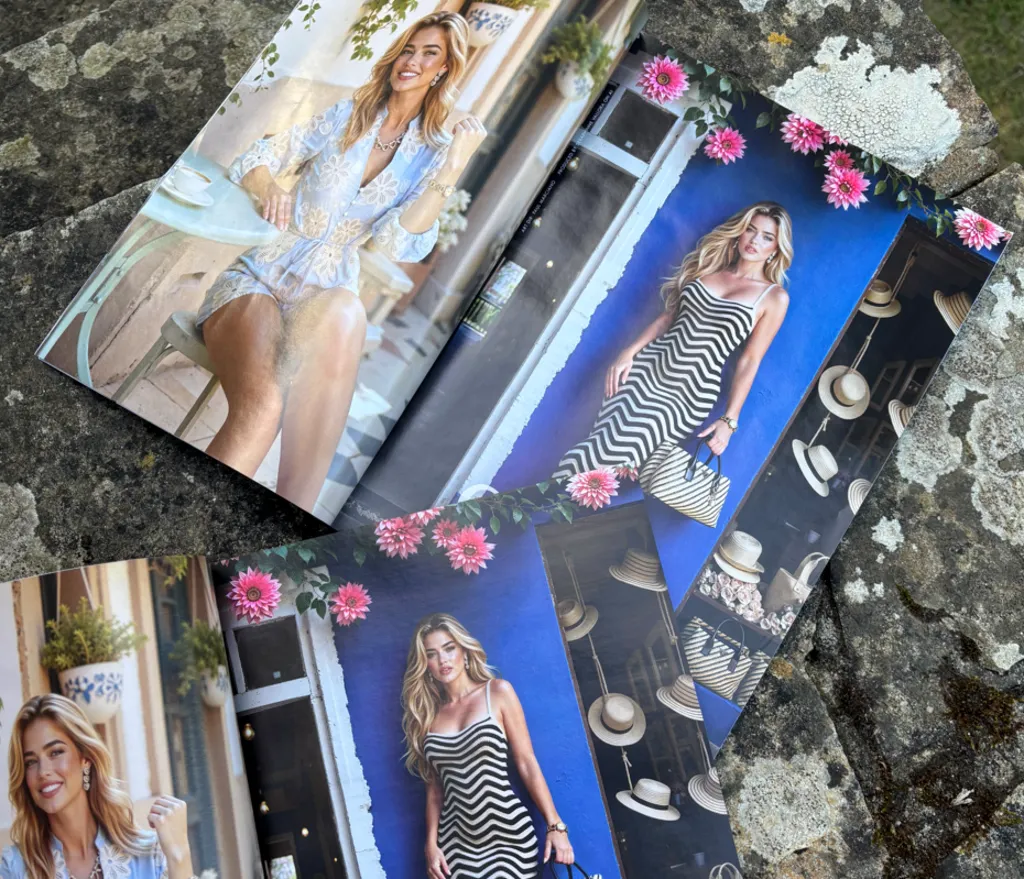
Last week, Vogue’s August print edition featured a double-page Guess campaign fronted by a stunning blonde model clad in a floral playsuit and striped maxi dress.
Her name? None. Her origin? Artificial intelligence.
Tucked discreetly into a corner of the ad, a small disclaimer confirmed it: the model wasn’t real.
She was created by AI modelmakers Seraphinne Vallora, at the request of Guess co-founder Paul Marciano.
Cue controversy.
This marks the first time an AI-generated model has appeared in Vogue, a magazine often described as fashion’s “Supreme Court.”
Although Vogue was quick to stress that the ad was a paid placement and not an editorial decision, its inclusion signals a shift that goes far beyond catwalks and couture.
For marketers, advertisers, and brand custodians, it begs urgent questions about ethics, aesthetics, diversity—and what we value as “real” in an age of synthetic perfection.
More Than Just a Pretty (Non-Existent) Face
Seraphinne Vallora, founded by architecture graduates Valentina Gonzalez and Andreea Petrescu, specialises in designing hyper-realistic AI models.
According to them, the Guess campaign took nearly a month to develop, involved multiple iterations, and costs can stretch into the six-figure range.
Despite the craftsmanship, their digital muses are almost indistinguishable from traditional supermodels—tall, slim, white, with symmetrical features and immaculate skin.
To their critics, that’s precisely the problem.
“Even real supermodels can’t compete with this,” said one social media user, reflecting a rising wave of frustration.
Felicity Hayward, a pioneering plus-size model, went further, calling the campaign “lazy and cheap” and warning that it undermines hard-won progress towards greater diversity in fashion.
In the 2010s, there was real momentum: trans visibility with Valentina Sampaio, religious inclusion with Halima Aden, and body positivity with brands like Savage x Fenty.
But the rise of AI-generated perfection could undo that in a few keystrokes.
The Illusion of Inclusivity
Seraphinne Vallora insists it doesn’t reinforce narrow beauty ideals.
“Actually, the AI model for Guess looks quite realistic,” says Petrescu.
But even Gonzalez admits that posts featuring models with darker skin tones or less conventional features receive far less engagement on social media.
“We’ve posted AI images of women with different skin tones, but people do not respond to them. We don’t get any traction or likes,” she told the BBC.
Diversity, even in AI, doesn’t convert to clicks.
And when the algorithm governs what gets seen, marketed, and paid for, the results are predictable—and disappointing.
The pair also claim that technology isn’t yet advanced enough to create convincing plus-size AI models, which feels like a curious cop-out in 2025.
If AI can generate high-resolution images of non-existent supermodels, surely it can also simulate curves?
Or is the real limitation not technological—but societal?
Photoshop on Steroids
The advertising industry has long battled accusations of promoting unattainable beauty standards.
Dove’s 2024 AI campaign exposed this perfectly: when prompted to generate the “world’s most beautiful woman,” image engines consistently returned images of young, thin, white, blonde women with blue eyes.
But unlike traditional photo retouching—which at least began with a real person—AI models are built from scratch.
They are unblemished by pores, scars, wrinkles, or any of the charming imperfections that make us human.
In bypassing the human altogether, these avatars become flawless, but also soulless.
That has real-world impact.
“Poor body image increases the risk of developing eating disorders,” said Vanessa Longley, CEO of eating disorder charity Beat.
“If people are exposed to images of unrealistic bodies, it can affect their thoughts about their own body.”
The consequences, particularly for young, impressionable audiences, are deeply concerning.
When you’re marketing to Gen Z—already grappling with anxiety, identity, and digital overexposure—adding AI avatars as aspirational ideals may do more harm than good.

The Human Cost of Cost-Cutting
Seraphinne Vallora claims their tech doesn’t eliminate jobs, but “supplements” traditional modelling.
Yet their website proudly touts “cost-efficiency” as a key benefit—no need for venues, makeup artists, lighting crews, travel budgets, or, indeed, human models.
Sara Ziff, founder of Model Alliance and a former model herself, points out that the modelling ecosystem includes far more than just the person in front of the camera.
Entire crews depend on each campaign from stylists and assistants to set builders and creative directors.
So while AI may streamline expenses, it also risks gutting the ecosystem.
And the slippery slope from “supplement” to “replacement” is all too familiar.
Marketing’s Moral Crossroads
What does all this mean for the advertising world?
Brands love innovation. But innovation without ethics becomes exploitation.
And while AI models might be cheaper and more controllable, they also represent a risk—a brand backlash waiting to happen.
Already, Vogue’s inclusion of the Guess ad has prompted online fury.
“Vogue has lost credibility,” one user posted. Others accused the magazine of “normalising synthetic ideals.”
If the gatekeepers of fashion are seen to endorse fake perfection, what message does that send?
For marketers, the lesson is clear: the future of advertising must be both innovative and inclusive.
AI is a tool—powerful, yes—but not a substitute for authenticity, representation, or responsibility.