For a man who built one of the world’s most disruptive fashion platforms while remaining almost invisible, Xu Yangtian — better known as Sky Xu — chose his moment carefully.
His rare public appearance at the High-quality Development Conference in Guangdong was not merely ceremonial. It was strategic signalling.
In a live-streamed address, Xu reaffirmed Shein’s commitment to China’s manufacturing heartland, pledging a 10bn yuan investment to build a high-tech fashion hub in the province.
He credited Guangdong’s “world-class business environment” and “complete industrial ecosystem” as inseparable from Shein’s rise.
For marketers and brand strategists, this was less about nostalgia and more about narrative recalibration.
Re-rooting the Brand
Over the past few years, Shein has deliberately internationalised its identity — shifting headquarters to Singapore and pursuing potential listings in New York and London.
That repositioning was widely interpreted as insulation against geopolitical risk.
Now comes the counterbalance.
By publicly anchoring Shein back to Guangdong, Xu is reframing the company not as a stateless e-commerce disruptor, but as a platform powered by industrial depth.
In marketing terms, this is a pivot from “borderless app” to “engineered ecosystem.”
For a brand under scrutiny, manufacturing credibility matters.
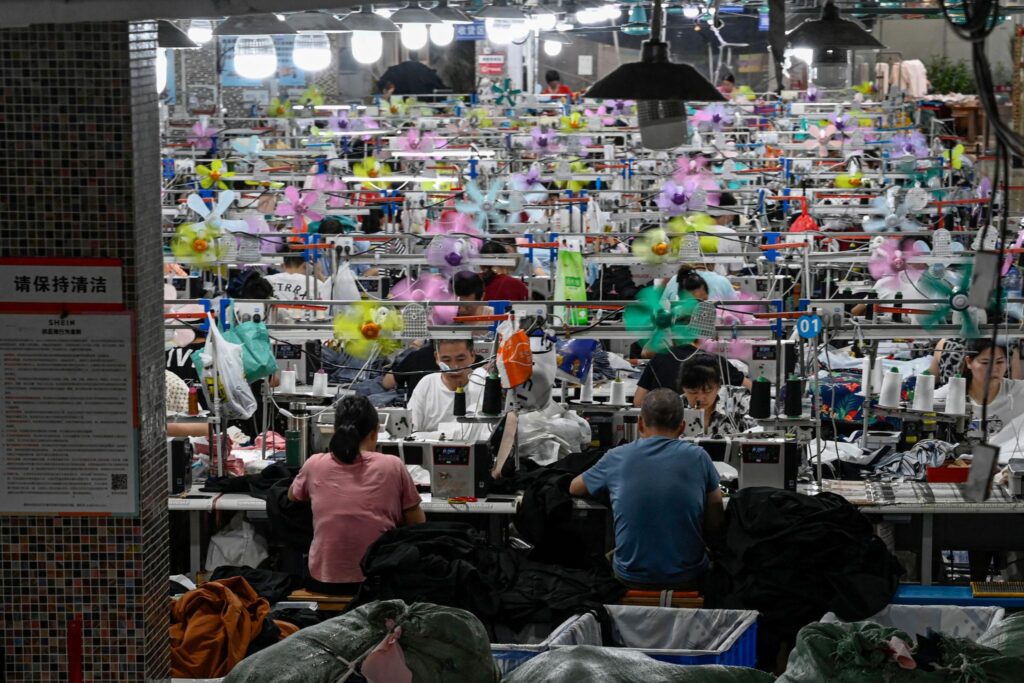
Guangzhou’s garment factories — the backbone of Shein’s rapid design-to-delivery model — allow it to translate micro-trends into finished garments in weeks.
That supply-chain velocity is not just operational advantage; it is brand DNA.
Xu’s speech effectively re-positions Guangdong as Shein’s innovation lab rather than its political liability.
Manufacturing as Brand Story
In Western markets, Shein has been cast primarily as a fast-fashion juggernaut: ultra-low prices, TikTok virality, algorithm-driven merchandising.
But in China, the story reads differently.
It is about digital enablement of small and mid-sized factories.
Xu claimed Shein supports more than 600,000 jobs in the region — a figure that underscores economic integration rather than extractive outsourcing.
That framing is important at a time when:
By emphasising long-term infrastructure investment rather than opportunistic sourcing, Xu is reframing Shein as a systems builder.
Whether that narrative sticks globally is another matter.
The Geopolitical Tightrope
The timing of Xu’s remarks is notable.
Tensions between Beijing and Western regulators have intensified scrutiny of Chinese-linked tech firms.
Shein’s planned listings have faced delays.
Meanwhile, protests in Paris over its physical retail expansion highlight the reputational fragility of fast fashion in Europe.
Against that backdrop, Xu’s public alignment with Guangdong can be interpreted in three ways:
For years, Xu maintained near-mythical anonymity.
In platform economics, invisibility can be strategic.
But in politically sensitive markets, silence becomes vulnerability.
His appearance suggests Shein understands that scale demands visibility.
From Fast Fashion to Industrial Platform
Shein’s competitive advantage has never been simply price.
It is data-driven demand forecasting paired with hyper-responsive manufacturing.
The 10bn yuan commitment to a “high-tech fashion hub” signals the next phase: digitised supply-chain optimisation at even greater scale.
Expect more AI-assisted production planning, tighter inventory cycles, and deeper factory integration.
In marketing terms, this opens a potential repositioning opportunity.
If Shein can credibly shift perception from disposable trend machine to digitally-enabled manufacturing ecosystem, it moves the conversation.
The risk, however, is that brand perception lags operational reality.
European regulators and sustainability advocates are unlikely to be swayed by investment headlines alone.
Why This Matters to Marketers in Malaysia and Beyond
For Malaysian marketers watching regional supply chains shift — especially as Visit Malaysia 2026 and broader ASEAN trade flows accelerate — Shein’s recalibration offers lessons:
In the era of platform capitalism, geopolitical literacy is now part of brand management.
Xu’s rare public appearance was not a routine speech.
It was a signal that Shein is preparing for a more contested, regulated and politically charged growth phase.
Fast fashion built Shein.
Industrial strategy may determine whether it endures.