
Preparing for what’s next.
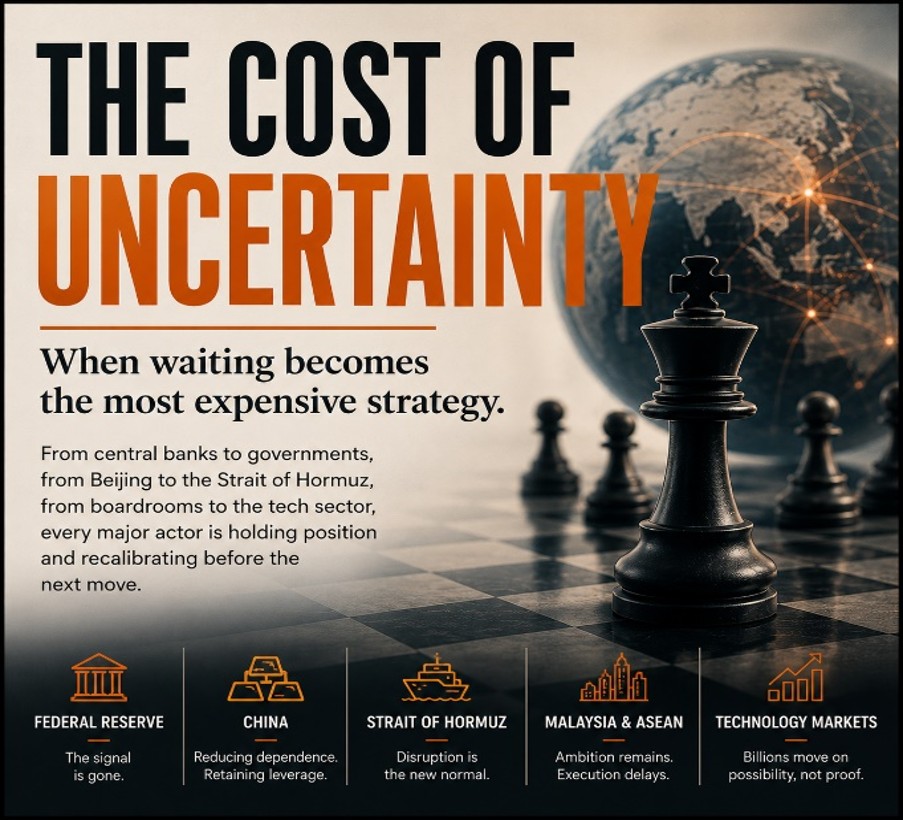
The biggest story this week wasn’t what happened. It was what didn’t happen. Across governments, markets and boardrooms, the dominant strategy was to hold position. While that may not make the front page, it tells us a great deal about where the world is right now.
What connects these developments is a common pattern. The United States, China and the major economies of Southeast Asia are each, in their own way, building for a world they believe is coming rather than managing the one that exists.
That is a meaningful shift. For most of the past three decades, geopolitical competition expressed itself through negotiation, alliance and occasional confrontation. Increasingly, it expresses itself through infrastructure: who controls the monetary signals, the critical minerals, the shipping lanes, the semiconductor supply chains and the governance frameworks that everyone else depends on.
The US Federal Reserve held its benchmark rate for a fourth consecutive meeting. What is significant is not the decision itself but what the new chair, Kevin Warsh, chose not to do alongside it. For three decades, markets relied on forward guidance to price risk and allocate capital.
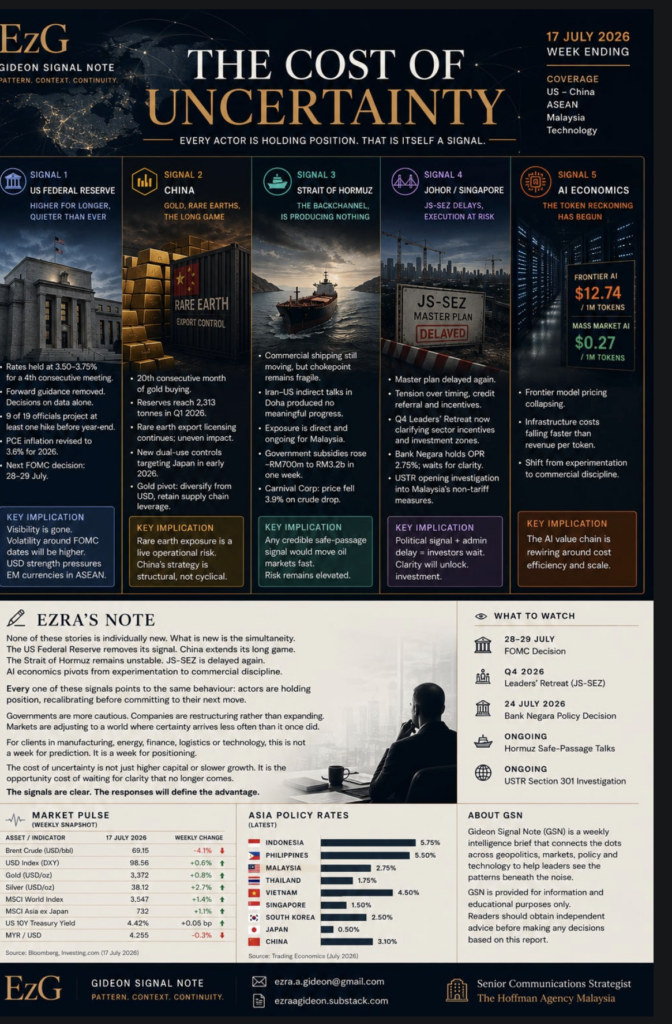
Warsh has removed it. He declined to submit his own projection to the dot plot, the mechanism through which officials signal rate expectations.
Every other FOMC member submitted theirs. The chair of the world’s most powerful central bank chose not to show his hand, even anonymously.
For executives managing dollar exposure or cross-border investment in Southeast Asia, the implication is direct: the signal they have traded on for a generation is gone.
The silence in Beijing is of a different register. China has extended its gold buying for a twentieth consecutive month while simultaneously tightening rare earth export controls in ways that affect US companies far more than European ones.
The pattern is clear: reduce dependence on the dollar system while retaining strategic leverage over the supply chains that power the technology economy.
These are not economic instruments deployed for commercial advantage. They are geopolitical ones, a distinction that matters for every government in Southeast Asia attempting to attract semiconductor investment while maintaining productive relationships with Beijing.
The same pattern is emerging in technology. Three major technology companies moved markets by tens of billions of dollars in a single week.
SK Hynix listed on Nasdaq, reflecting the irreplaceable position of its memory chip inside every advanced AI processor.
Microsoft eliminated thousands of positions in an explicit AI restructuring while simultaneously cancelling its internal AI licences from a leading US frontier lab, two moves pointing in the same direction: enterprise AI billing models are under strain.
Nvidia surged nearly four percent on a single unconfirmed report about semiconductor access for China. That a single unverified item moved one of the world’s most valuable companies by that magnitude is itself the signal.
Malaysia offers a reminder that positioning is not only happening between countries. It is happening within them. The delayed Johor-Singapore Special Economic Zone master plan has exposed a growing tension between ambition and execution.
Johor has already attracted RM110 billion in approved investments without the plan, yet local leaders are warning that every delay gives competing investment destinations an opportunity to gain ground.
The common thread in all of these examples is not chaos. It is deliberate positioning. Governments, markets and companies are keeping their options open because committing too early now carries greater risk than waiting. Uncertainty, it turns out, is not an absence. It is a condition. And conditions must be managed rather than waited out.
The most powerful position in today’s world is not the one that threatens others. It is the one that others cannot afford to lose.
___________________________________________________________________________

Ezra A. Gideon, IABC, is Senior Communications Strategist at The Hoffman Agency Malaysia, a geopolitical intelligence adviser and author of the weekly Gideon Signal Note. Read more at ezraagideon.substack.com or contact him at ezra.a.gideon@gmail.com