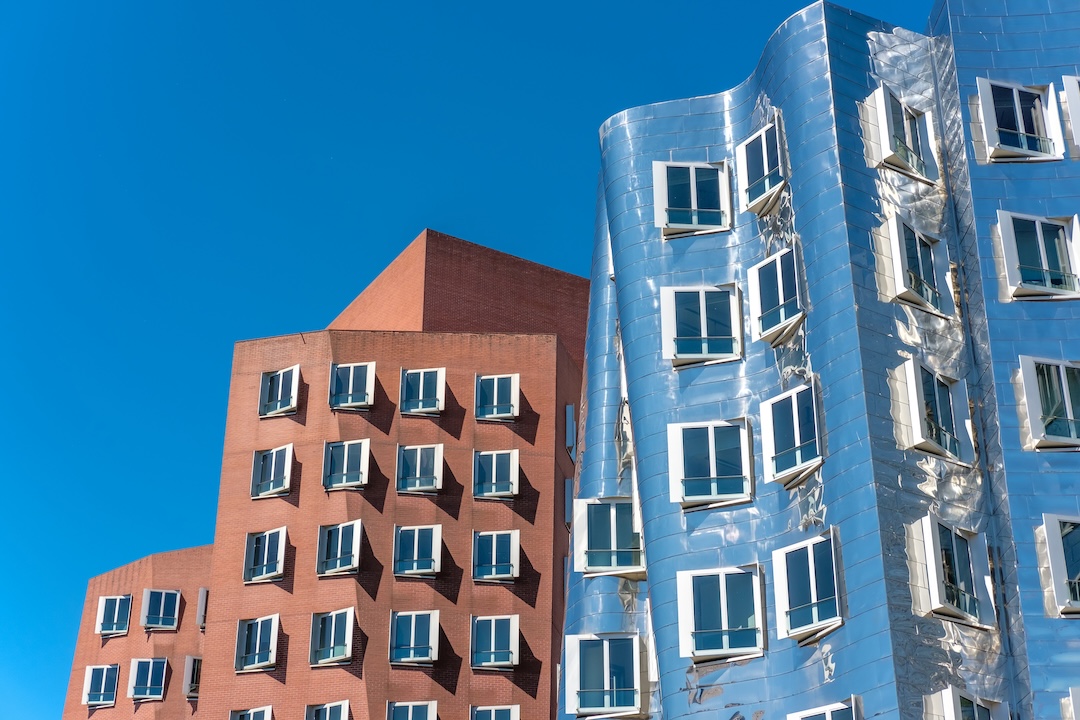
Frank Gehry never designed buildings. He designed arguments — and entire cities listened.
Now, with his passing at 96, the global architecture and creative community find themselves doing something Gehry himself never allowed his work to do: stay still.
His death marks the end of an extraordinary life, yet his legacy remains defiantly kinetic — twisting, folding, and muttering, “Try harder.”
A Man Who Was Never Content with Straight Lines
Born Frank Goldberg in 1929 Toronto, Gehry moved to Los Angeles in the 1940s and, like many great creators, began by questioning everything that was considered good taste.
Plywood? Corrugated metal? Chain-link fencing?
Architects clutched their pearls.
Gehry shrugged — and stapled a new movement into place.
His early experiments told the world what would become his lifelong philosophy: architecture shouldn’t just sit politely in a city — it should change the rhythm, challenge the narrative, and make the spectator feel something, ideally confusion before awe.
The Bilbao Effect: When a Building Becomes a Global Marketing Case Study
Every marketer knows the phrase.
Before Gehry, the idea that one building could rebrand an entire city seemed absurd. After the Guggenheim Museum Bilbao opened in 1997 — wrapped in wild titanium waves and sculptural defiance — global tourism economics changed.
A sleepy Spanish port became a global cultural destination.
Economists studied it. Mayors envied it. Tourism boards worshipped it.
It wasn’t just architecture — it was one of the greatest brand repositioning ever attempted, and it worked.
Gehry didn’t just disrupt skylines. He disrupted city planning, tourism, and civic ambition.
In marketing terms: Bilbao went from unknown commodity to premium category leader — without a single ad campaign.
Brand Gehry: A Creative Icon in Pop Culture
It says something when The Simpsons calls.
In 1998, Gehry appeared as himself in an episode where he transforms a crumpled scrap paper into a civic building (a joke he later claimed people assumed was true — and he wasn’t entirely offended).
He became one of those rare creatives whose style was so distinctive that it became imitable.
Like Warhol. Like Gaudí. Like Steve Jobs.
Even critics who disliked his work had to admit — they always knew a Gehry when they saw one.
And in an era obsessed with data, sameness, and risk-avoidance, Gehry proved that unmistakability is still the most powerful branding strategy of all.
Technology Before It Was Cool
Long before “AI“, “digital modelling”, or “parametric design” became buzzwords, Gehry was already rewriting workflows.
His studio adopted advanced 3D modelling software originally used for aerospace engineering. While most architects were still sketching front elevations, Gehry was digitally bending steel like it was silk.
Design became performance.
Machines became collaborators.
Ideas that could not exist in the analogue era suddenly had shape, shadow, and sound.
The result? Buildings that looked like motion — frozen.
Loved, Loathed, But Never Ignored
Ask critics and they’ll tell you: Gehry was reckless, impractical, irrational.
Ask his admirers and they’ll counter: he was fearless.
Architecture has its conservatives — and Gehry never asked them for permission.
He collected headlines, complaints, cult followings and awards in equal measure, including the Pritzker Prize in 1989, the industry’s equivalent of the Nobel.
His structures — from Prague’s Dancing House to the Fondation Louis Vuitton to the Walt Disney Concert Hall in Los Angeles — weren’t just buildings.
They were arguments with gravity.
What Gehry Leaves Behind
A generation of architects who now believe buildings can move — even when they stand still.
A lesson to every creative industry battling mediocrity: risk is the oxygen of relevance.
And a reminder to marketers:
Gehry’s structures still spark debate, awe, confusion, and excitement. Which may be the most faithful metric of his success.
Because in the end, Frank Gehry didn’t want applause.
He wanted reaction.
And the world — architects, marketers, city planners, students and dreamers — will continue reacting for generations.
Perhaps the greatest tribute to Frank Gehry is this — no one will ever call his work timeless.
His work isn’t timeless.
It’s alive.
And it refuses to sit still.
Share Post:
Haven’t subscribed to our Telegram channel yet? Don’t miss out on the hottest updates in marketing & advertising!