There are many products in the world that claim to improve lives. Far fewer begin by understanding how people actually live.
That may explain why a simple brooch-shaped hearing aid from Indonesia is drawing attention far beyond the worlds of healthcare and advertising.
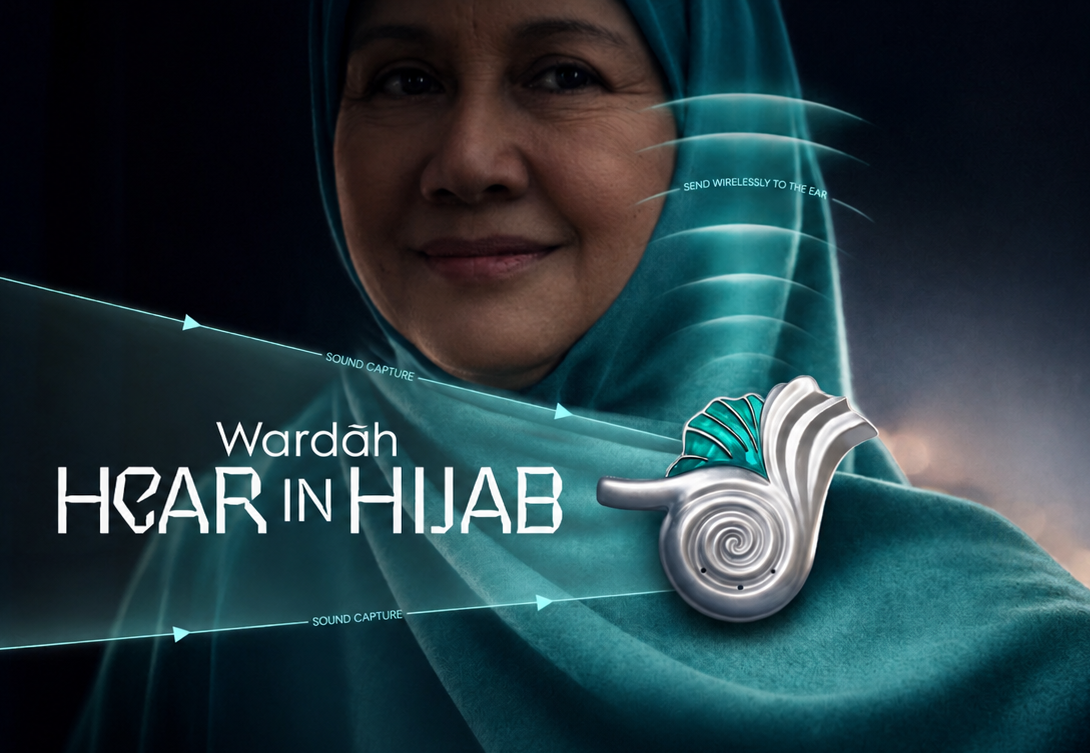
Developed by Dentsu Indonesia and halal beauty brand Wardah, “Hearin Hijab” addresses a challenge that has long remained hidden in plain sight: how conventional hearing aids often fail Muslim women who wear the hijab.
For many hijab-wearing women experiencing hearing loss, fabric covering the ears can muffle sound further, making daily movement more difficult and, in some cases, dangerous.
Yet most hearing aids globally are still designed with uncovered ears in mind. The result is a quiet but very real gap between product design and lived reality.

A Hearing Aid Reimagined As Everyday Wear
Hear in Hijab attempts to close that gap with an idea so intuitive one wonders why nobody thought of it earlier.
Instead of sitting inside the ear beneath layers of fabric, the device is worn externally as a brooch pin on the hijab itself.
From there, it captures sound unobstructed and wirelessly transmits it to the ear with clarity reaching up to 100dB. At just 12 grams, it is lightweight, adjustable and compatible with most hijab fabrics.
But what makes the innovation resonate is not merely the engineering. It is the empathy behind it.
In an era where brands often speak loudly about inclusion while producing generic solutions, Hear in Hijab feels refreshingly observant. It begins not with technology, but with behaviour, faith, dignity and routine.
Designing Around Real Lives
Indonesia, home to the world’s largest Muslim population, provided the perfect context for such an insight.
According to the campaign’s supporting data, one in three Indonesian Muslim women aged between 50 and 70 experiences partial hearing loss. Combined with fabric covering the ears, reduced sound clarity can increase the risk of falls and accidents significantly.
Most people in advertising spend years talking about “consumer understanding”. This project demonstrates what that phrase looks like when taken seriously.
Wardah, a brand deeply associated with Muslim women in Indonesia, appears to have recognised that beauty and wellbeing are not separate conversations.
Khikin Indahsari, Group Head New Brand Innovation at Paragon Technology and Innovation, describes the hijab not merely as clothing, but as an expression of faith, identity and confidence. That distinction matters.
Too often, products designed for marginalised or overlooked communities carry the subtle message that users must adapt themselves to existing systems.
Hear in Hijab flips the equation. The product adapts to the woman, not the other way around.
The Marketing Lesson Hidden Inside The Design
For marketers, there is another lesson quietly embedded here.
The most meaningful innovation opportunities may no longer lie in inventing entirely new categories, but in noticing who existing systems accidentally exclude.
That exclusion is not always dramatic. Sometimes it is found in the small discomforts people stop talking about because nobody expects solutions anyway.
A hearing aid that does not work optimally beneath a hijab may seem like a niche problem inside a boardroom presentation.
But to the woman navigating traffic, conversations, prayer gatherings or crowded markets every day, it is deeply personal. And perhaps that is why the campaign has struck such a chord.
Rather than turning disability into spectacle or emotional manipulation, the work feels restrained and respectful. The design itself does most of the storytelling.
Defri Dwipaputra, Chief Creative & Experience Officer at Dentsu Creative Indonesia, described Indonesia as a country of “layered lives, deep faith, and needs that resist easy generalisation.”
That may well be the line many agencies across Asia should pin onto their walls.
Because the future of meaningful creativity in this region may depend less on louder campaigns and more on culturally intelligent design.
Beyond Awareness Into Usefulness
Hear in Hijab has already won the Grand Prix of Medium at Indonesia’s prestigious Citra Pariwara awards.
But its greater achievement may be demonstrating how brands can move beyond awareness campaigns into practical usefulness.
Not every brand needs to save the world. But more brands could start by paying closer attention to the worlds people already inhabit.
Sometimes the most powerful innovation is not about inventing something futuristic. It is about finally noticing someone everyone else overlooked.