In most corners of the internet, the phrase “Nigerian prince” still triggers a reflex. Delete. Ignore. Move on. Vaseline has decided to do the opposite.
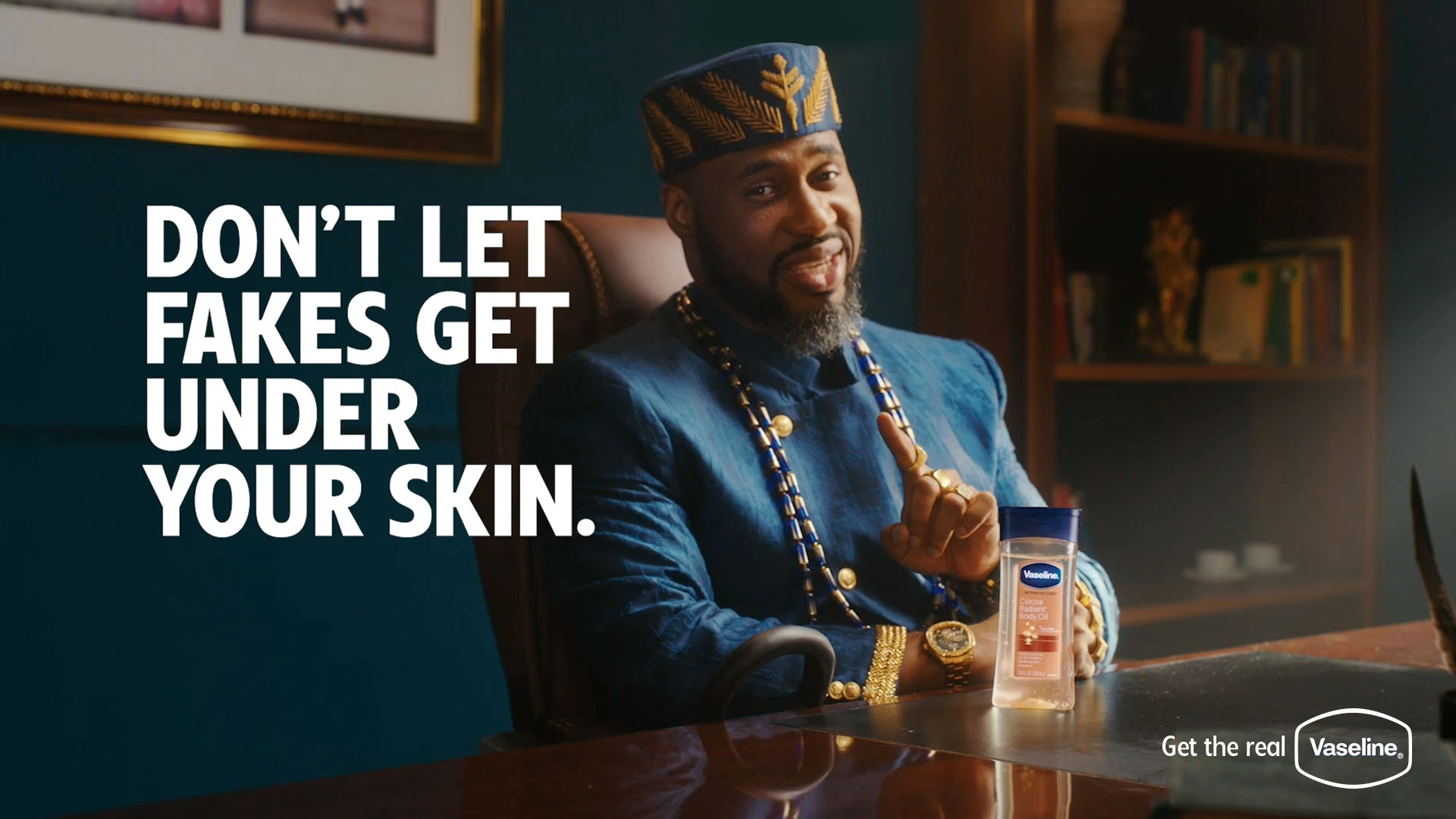
In a campaign conceived out of Singapore by Leo Burnett Singapore for Unilever, the brand has recruited a real Nigerian royal, Prince Chris Okagbue, to take on a problem that is far less amusing than email scams: counterfeit skincare products circulating widely across Nigeria.
It is an idea that works because it leans into a stereotype and then calmly dismantles it.
A Market Where Trust Is Fragile
Counterfeiting is not new, but in categories that sit directly on the skin, the stakes are personal.
The global trade in fake goods runs into hundreds of billions of dollars, and Nigeria’s fast-growing beauty market has become a fertile ground for imitation products.
For consumers, the risk is not just financial. A counterfeit moisturiser is not a harmless knockoff handbag. It can carry unregulated ingredients, cause reactions, and erode confidence in brands that have spent decades building trust.
Enforcement exists, but it moves at the speed of bureaucracy. By the time a raid is conducted, or a shipment seized, the damage at the shelf has often already been done.
Vaseline’s response is not to wait for enforcement to catch up. It is to move the moment of truth into the hands of the consumer.
The Authenticator in Your Pocket
At the centre of the campaign is a simple tool with a deceptively powerful premise.
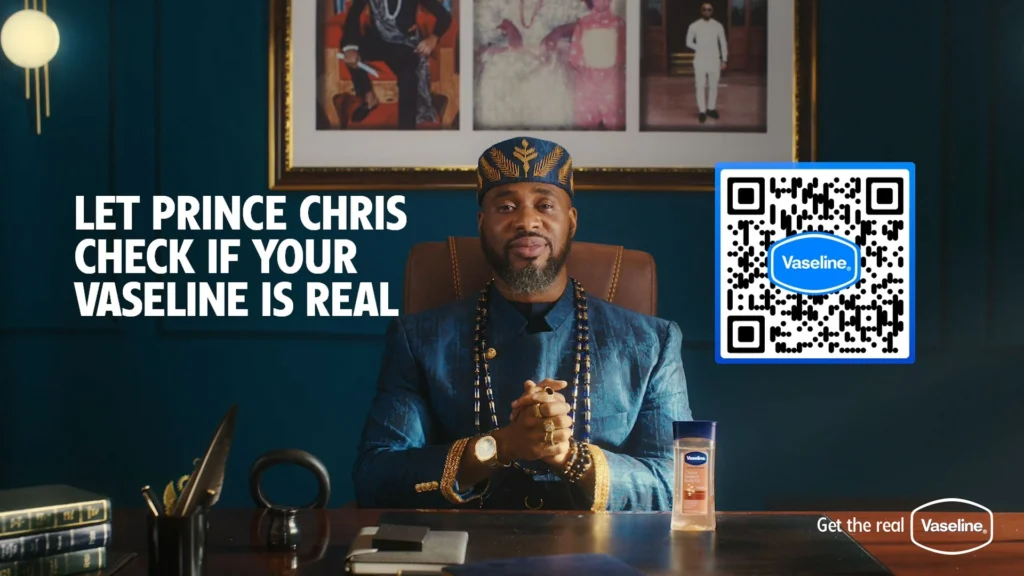
The “Vaseline Authenticator” runs on WhatsApp, the same app millions of Nigerians already use daily. A shopper scans a QR code or taps a link and enters a chat. From there, they are guided to upload photos of the product in question. Within moments, they receive a verdict: genuine or fake.
There is no app to download, no new behaviour to learn. It fits into existing habits, which is often where many well-intentioned brand solutions fall short.
What is striking is how untheatrical the technology is. No blockchain sermon. No futuristic packaging overhaul. Just a conversation, an image, and an answer.
Reclaiming a Punchline
The campaign’s real lift, however, comes from its choice of messenger.
For years, the “Nigerian prince” has been shorthand for deception. It is one of the internet’s most persistent jokes. By placing an actual prince at the centre of the narrative, the campaign performs a neat inversion.
Prince Okagbue addresses the trope head-on in the film. He acknowledges the myth, plays with it, and then pivots. Here is a real prince, he suggests, dealing with something real.
In one scene, he holds up a bottle that appears legitimate, only to dismiss it as counterfeit. The gesture is small but symbolic. Appearances are not enough.
The line that follows, “Don’t let fakes get under your skin,” lands because it is grounded in both humour and consequence.
From Communication to Utility
There is a shift happening in how brands approach markets where trust is uneven. Traditional campaigns would have leaned on awareness. Posters warning consumers about fakes. Messaging about buying from authorised retailers. Perhaps a hotline buried somewhere on a website.
This work does something else. It builds a piece of utility and wraps communication around it.
The out-of-home placements across Lagos neighbourhoods like Lekki and Surulere carry QR codes that do not just inform but activate. Retail environments, from large chains to neighbourhood stores, become entry points into a verification system.
In effect, the campaign turns every touchpoint into a checkpoint.
A Lesson Beyond Nigeria
While the initiative is local in execution, the implications travel. Counterfeiting is not confined to Nigeria. From Southeast Asia to parts of Eastern Europe, similar challenges exist across categories from cosmetics to electronics. What differs is how brands respond.
Vaseline’s approach suggests that in markets where institutional trust may lag, brands can step in to provide micro-certainty. Not through grand promises, but through small, repeatable proofs.
There is also a lesson in tone. Rather than adopting a stern, cautionary voice, the campaign uses wit. It invites participation rather than issuing warnings.
That balance is not easy to strike. Too much humour and the issue feels trivialised. Too much seriousness and it becomes ignorable. Here, the presence of a real prince anchors the idea just enough to let the humour do its work.
When Creativity Solves a Business Problem
For all its charm, the campaign is rooted in a hard commercial reality. Counterfeits erode revenue, distort distribution, and weaken brand equity.
What Leo Burnett Singapore has done is to treat the brief not as a communications challenge, but as a business problem that requires a usable solution. It is the kind of work agencies often talk about but rarely deliver at scale.
The irony, of course, is that it took one of the internet’s oldest scams to restore a measure of trust in a very real marketplace. In doing so, Vaseline has offered a reminder. Sometimes the most effective way to fight deception is not to shout louder, but to make the truth easier to see.