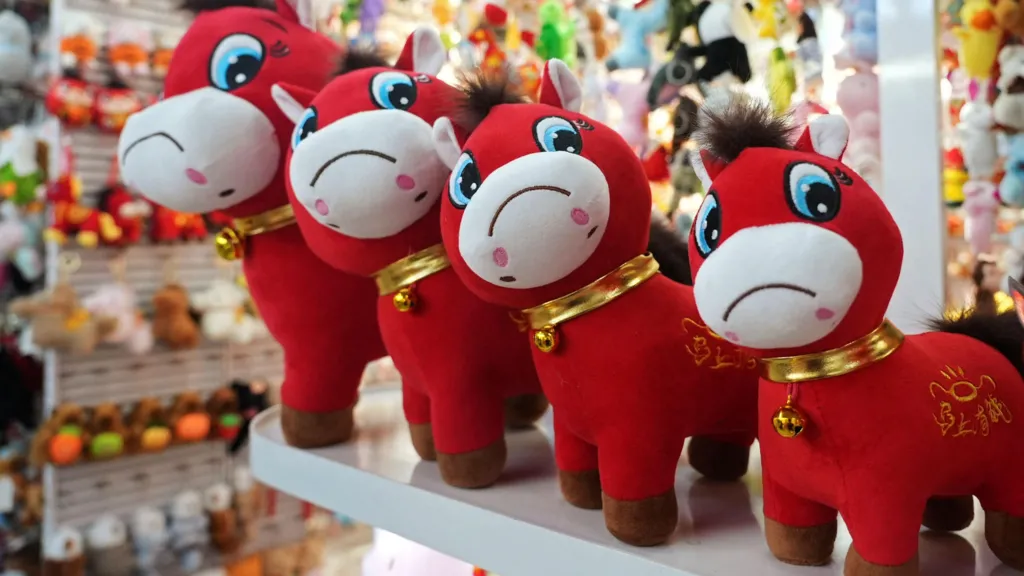
Somewhere in Yiwu, China, the world’s most industrious factory town, a seamstress stitched a smile upside down.
And, she accidentally created the most honest brand mascot of the Year of the Horse.
Meet the crying horse: red, plush, vaguely miserable, and inexplicably sold out.
It wasn’t conceived in a brainstorm.
There was no cultural insight deck. No brand purpose manifesto.
Just a production error that escaped quality control and wandered into the internet — where it was immediately adopted by China’s young working population as a plush embodiment of their weekday souls.
This is important.
Because the crying horse is not cute.
It is not aspirational.
It is not uplifting.
It looks like it has just finished a 12-hour shift, checked its bank balance, and remembered it still has Slack notifications waiting.
And that is precisely why it works.
For years, brands have insisted on selling happiness at full gallop.
Smiles stretched too wide. Optimism laid on thick.
Every New Year campaign promising abundance, growth, and “better things ahead” — preferably in gold foil.
But the crying horse quietly rebels against all that.
It says: Yes, money comes quickly (the phrase is literally embroidered on it).
But first, let me cry a bit.
This is not irony for irony’s sake.
It’s emotional truth.
And young consumers, especially in high-pressure urban economies, have developed a finely tuned radar for emotional dishonesty.

They don’t want brands that cheerlead.
They want brands that understand.
The toy’s sudden fame wasn’t driven by humour alone.
It was driven by recognition.
“Crying at work, smiling after work,” as one buyer put it.
That single sentence contains more insight than most annual brand tracking reports.
Modern life has split people into two characters:
The professional self, held together by deadlines and emojis.
And the private self, desperately clawing back joy after clocking out.
The crying horse collapses that contradiction into one object.
It allows people to laugh at the absurdity of it all — without pretending the absurdity doesn’t exist.
This is where marketers should stop scrolling and start thinking.
For years, “emotional connection” has been shorthand for uplifting narratives.
But emotion isn’t a one-note instrument.
It includes fatigue. Disillusionment. Quiet resentment. Gallows humour.
The soft sigh at 11.47pm on a Sunday night.
The crying horse doesn’t resolve tension.
It acknowledges it.
That alone makes it feel more human than most brand mascots.
Interestingly, even sellers who personally find the toy “ugly” recognise its value.
Not aesthetic value. Emotional value. Which is the currency that matters now.
We are entering an era where brands don’t win by being admired from afar.
They win by sitting beside consumers on the couch — slightly slumped, equally tired, but still oddly hopeful.
This doesn’t mean brands should all turn gloomy. Or wallow. Or trade joy for despair.
It means sincerity matters more than sheen.
The crying horse still wears red for luck.
It still promises prosperity.
It just doesn’t pretend the journey there is painless.
That nuance is what makes it modern.
The lesson here is simple, and deeply uncomfortable for marketing departments:
Consumers are no longer asking brands to make them feel better.
They’re asking brands to tell the truth first.
Once you do that, laughter follows naturally.
So does loyalty.
Sometimes, the most powerful brand insight doesn’t come from strategy.
It comes from a mistake that looks a bit like how everyone feels — just before payday.