There is a hard truth every good marketer learns early—usually after a bruising pitch loss or a failed campaign:
You don’t get to decide what your brand means. The market does.
Which is why the recent saga involving firebrand UMNO Youth Chief Dr Muhamad Akmal Saleh is not really a political story at all.
It is a branding one. And a brutal one.
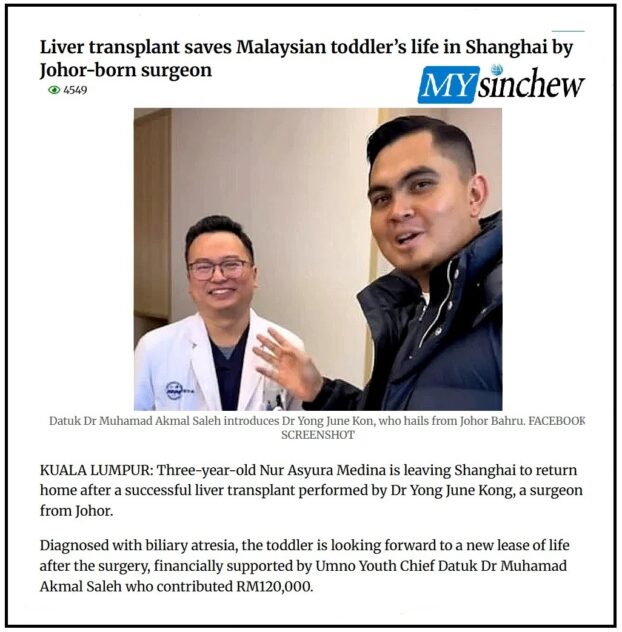
On paper, the Shanghai episode had all the ingredients of a redemption arc. Akmal paid RM120,000 of his own money—money set aside for his haj—to save the life of a three-year-old Malaysian child through a liver transplant in China. No government grant. No corporate sponsor. No soft-focus video.
Just a human act.
If this were a brand campaign, every planner in the room would have nodded. Strong insight. Genuine sacrifice. Clear emotional payoff.
And yet, the market isn’t convinced.
Not because the act wasn’t real—but because the brand carrying it wasn’t believable.
The Brand Baggage He Forgot to Account For
Brands do not exist in isolation. They exist in context. And Akmal’s context is years of loud, combative identity politics—where race and religion were not values to protect but weapons to deploy.
So when the public looked at Shanghai, they didn’t see a hero story. They saw a contradiction.
And then they noticed something else.
The surgeon who saved the child—Dr Yong June Kong—was a Malaysian. From Segamat. Fluent in Bahasa Malaysia. Brilliant.
But not practising in Malaysia.
Dr Yong entered Universiti Kebangsaan Malaysia in 1997, hoping to study medicine. He didn’t make it into the medical faculty due to quota restrictions. He completed biomedical science instead—but regulatory barriers meant he still couldn’t practise as a doctor.
So he did something extraordinary.
He went to Tianjin Medical University in China and started again—from Year One. Five years. New language. New system. No shortcuts.
Years later, after relentless training, he became the first foreign doctorlicensed to practise medicine in China, eventually rising to perform complex paediatric liver surgeries at Shanghai’s Renji Hospital.
This is not a sob story. It is a case study in talent displaced by policy.
And here’s where Akmal’s brand truly collapsed.
When the Subtext Destroys the Headline
In branding, we talk about unintended messaging—what the audience reads between the lines.
The Shanghai story unintentionally said this:
Malaysia’s children are saved abroad by Malaysian doctors forced to leave Malaysia because of the system you defend.
No amount of personal generosity can outshout that.
This is where marketers should sit up.
Because we see this mistake all the time.
Companies launch mental-health campaigns after burning out staff. Brands talk about sustainability after years of extraction. CEOs speak about empathy after decades of fear-driven culture.
The market is not fooled. It is simply polite—until it isn’t.
Purpose Is Not a Press Moment
Creative Guru Neil French used to say advertising works best when it tells the truth—especially the uncomfortable kind.
The truth here is simple: purpose is not a one-off act. It is a pattern.
Akmal didn’t fail because he helped a child. He failed because his brand ecosystem couldn’t support that act without collapsing under its own contradictions.
In marketing terms, this wasn’t a rebrand. It was a misfired brand extension.
You cannot sell compassion from a platform built on exclusion. You cannot borrow humanity for one moment and return to hostility the next.

The Lesson for Marketers
This story isn’t about Akmal alone. It’s about every leader who thinks a single grand gesture can overwrite years of brand behaviour.
It can’t.
Brands—political or commercial—don’t change because of what they do once. They change because of what they do consistently, especially when no one is watching.
And the final, unforgiving rule of branding still applies:
If you want a different perception, you must first become a different brand.
Until then, the market will keep calling your bluff.