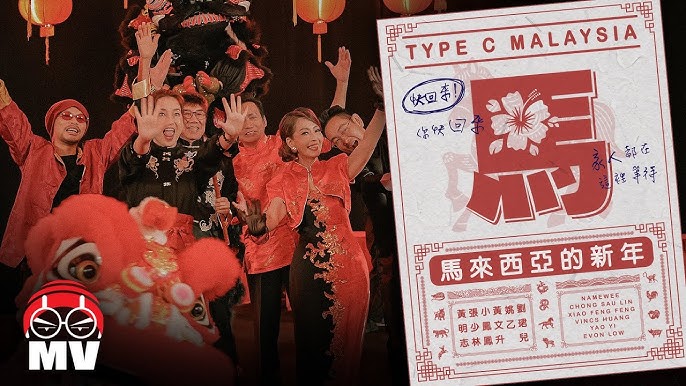
Namewee’s latest Chinese New Year release, Type C Malaysia, is not just a comeback single.
It is a reminder of something Malaysian marketers often forget when chasing algorithms, influencers and short-term reach—culture, when treated with care, still cuts through.
After weeks of legal uncertainty and tabloid-level attention, Wee Meng Chee has returned not with provocation for provocation’s sake, but with a layered, surprisingly generous piece of cultural storytelling.
The result is a music video that feels less like a stunt and more like a cultural archive—one dressed in pop colours, humour and melody.
That pivot matters.
From Button-Pushing to Meaning-Making
For years, Namewee’s brand has thrived on confrontation—pushing buttons, testing boundaries, and daring institutions to respond.
This time, the provocation is quieter, and arguably more effective. Type C Malaysia reframes a loaded phrase—“Type C”—not as insult or defence, but as self-authored identity.
In branding terms, this is textbook narrative reclamation: taking a term shaped by controversy and returning it to the community it describes.
It is not about denying tension, but about deciding who gets to define it.
Dialects as Substance, Not Surface
What makes the work resonate is not just intent, but execution.
The song features six Chinese dialects—Cantonese, Hokkien, Hakka, Hainanese, Foochow and Teochew—each represented by veteran singers and lyricists.
In a media environment obsessed with youth, novelty and velocity, Namewee has made a counter-cultural choice: to slow down, collaborate widely, and centre elders, dialects and ancestry.
Language here is not aesthetic garnish. It is the message.
For a generation of Malaysian Chinese who grew up code-switching, losing fluency, or being told their dialects were impractical or outdated, the song lands as recognition rather than nostalgia.
Heritage Branding Done the Hard Way
Across Asia, marketers speak fluently about “heritage branding” and “cultural authenticity”, often reducing both to surface cues—retro fonts, familiar motifs, a dusting of nostalgia.
Type C Malaysia goes deeper. It treats heritage as living practice, not visual shorthand.
The work acknowledges that identity in Malaysia is never singular. It is layered, regional, inherited—and often unfinished.
That distinction matters. Referencing culture is easy. Contributing to it is not.

Localisation as Authorship, Not Adaptation
The visual language reinforces this depth.
The six colours woven into the video are inspired by the Johor Ancient Temple Chingay Festival, one of Malaysia’s oldest communal rituals.
This is continuity at work—between clan, geography, ritual and modern expression.
Equally deliberate is the equatorial framing of Chinese New Year: sunlit, exuberant, humid.
It quietly challenges the default imagery of winter, snow and imported festive tropes, asserting a version of Chinese New Year that belongs unmistakably to Malaysia.
This is localisation done right—not as adaptation of a global template, but as authorship from within.
When Brand Partnerships Know Their Place
There is also a commercial subtext worth noting. The collaboration with GV Rides is restrained, almost invisible.
In an era where brand integrations often overwhelm content, this one understands its role: enabler, not headline.
For marketers, it is a useful reminder that cultural sponsorship works best when the brand supports relevance rather than competes with it.
Complexity as Credibility
Of course, Namewee remains a polarising figure, with unresolved legal proceedings still hovering in the background. Yet that tension may be precisely why this work feels timely.
In a fragmented media landscape, audiences are increasingly sceptical of polish and perfection. They respond to creators—and brands—who acknowledge complexity without rushing to resolve it.
The Real Question for Brands in 2026
As Malaysian brands plan their Chinese New Year briefs and broader 2026 strategies, Type C Malaysia offers a quiet but pointed lesson.
Cultural depth, when handled with respect and collaboration, still outperforms noise.
Representation is not about being seen, but about being understood.
And in a market saturated with performance metrics, the most enduring value may still lie in meaning.
The question for marketers is not whether culture matters.
It is whether they are willing to do the work it demands.