There is no screech of tyres. No slow-motion shattering glass. No swelling soundtrack telling you when to feel sad.
Instead, Toyota’s latest Thai road-safety film opens with something far more uncomfortable: certainty.
Aerial, clinical, almost God’s-eye in its detachment, the camera hovers over a quiet stretch of road.
It looks like the aftermath of an accident — except nothing has happened yet.
The wreckage is imaginary. The blood is still circulating. Time, crucially, is still on the driver’s side.
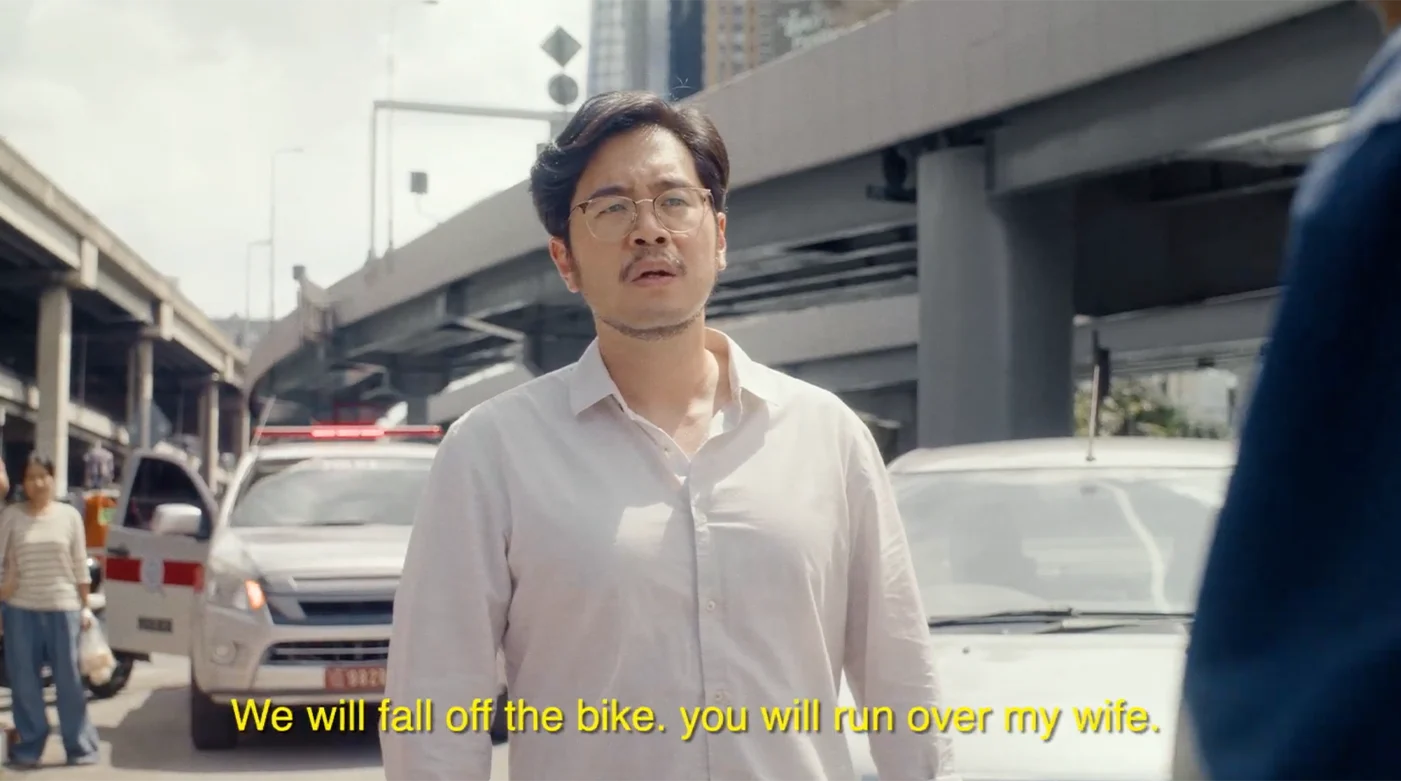
Then a motorbike rider appears. He approaches a car stopped at the roadside and calmly begins to explain the future.
“In 17 minutes, we will meet here. You will drive very fast.”
What follows is not a warning. It is a timetable.
A dog will run out. A swerve will happen. A collision will follow.
A wife will be crushed. A man will be thrown into a pole, break his neck, and die.
No hysteria. No raised voice. Just cause, effect, and consequence laid out like a meeting agenda.
This is Appointment, Toyota Thailand’s latest instalment under its White Road Project — and it may be one of the most quietly devastating pieces of road-safety communication produced in recent years.
The uncomfortable idea at its core
Most road-safety advertising operates on the same emotional axis: shock first, regret later. We see mangled cars, grieving families, hospital beds and funerals. The logic is simple — scare people enough and they’ll slow down.
But Appointment flips the emotional geometry.
It doesn’t show you the accident. It shows you the decision.
By framing speeding as something that happens before tragedy — not during it — the film removes the moral escape hatch drivers usually rely on. The one labelled “accident.”
Because an accident implies randomness. Bad luck. A moment that arrived uninvited.
This film suggests something far more disturbing: that many crashes are scheduled.
Not consciously, perhaps. Not maliciously. But through a series of everyday choices — pressing a little harder on the accelerator, shaving a few minutes off a journey, trusting reflexes over restraint — the driver has effectively pencilled in a meeting with consequence.
The brilliance lies in how calmly the idea is delivered.
No sermon. No statistics. No finger-wagging.
Just a man politely informing another man of what his future behaviour will cause.
Why Thailand matters — but doesn’t limit the message
Thailand’s roads are among the most dangerous in the world, particularly for motorcyclists. That context matters. But the film’s power is not geographical.
Every market understands speed. Every driver understands urgency. Every culture understands the small internal bargain we make: Just this once. I’ll be careful.
What Appointment does is expose that bargain for what it is — a fantasy of control.
The motorbike rider does not accuse the driver of being reckless now. He accuses him of being predictable later. That is far more unsettling.
Because it implies that the driver already knows what he will do.
And so do we.
Craft over carnage
From a creative standpoint, the film is an object lesson in restraint.
Directed by Wuthisak ‘Un’ Anarnkaporn, it avoids the familiar cinematic tricks of the genre. No rapid cuts. No visceral close-ups. The camera behaves like an impartial witness — or worse, like fate patiently waiting.
Hakuhodo First deserves credit for trusting the audience’s intelligence and emotional maturity.
This is not safety messaging for first-time drivers or driving-school classrooms. It is aimed squarely at adults who believe they are experienced enough to bend the rules without consequence.
In other words: the most dangerous drivers of all.
Responsibility, reframed
The closing line does not plead. It does not threaten.
“As long as the accident hasn’t happened, you can still change the outcome. Reduce speed.”
Notice what is absent: guilt.
The film does not ask you to imagine the grief you would cause. It asks you to acknowledge the power you already have. Responsibility is framed not as a burden, but as agency.
That is a subtle but crucial shift.
Fear-based road-safety campaigns often leave audiences paralysed. This one leaves them implicated — but also empowered. The accident is no longer an inevitability waiting around the bend. It is a future draft that can still be edited.

A lesson for marketers beyond automotive
For marketing professionals, Appointment offers a reminder worth sitting with.
The most effective communication does not always shout louder. Sometimes it speaks earlier.
By intervening before the dramatic moment — before impact, before regret, before mourning — Toyota turns a one-minute film into a moral pause button.
It creates space for reflection in a category that usually relies on shock to punch through indifference.
Perhaps that is the most uncomfortable truth the film reveals: people do not always need to be shown the worst outcome.
Sometimes, they just need to be shown the moment where everything is still preventable.
Seventeen minutes before impact.
That is not just a narrative device. It is a reminder of how thin the line really is between everyday behaviour and irreversible consequence.
And how often we pretend we don’t already know where the road is leading.