As Generative Artificial Intelligence (GenAI) increasingly becomes the primary source of information for consumer research, brands risk being isolated within echo chambers of loyal supporters.
This was one of the key insights revealed in the “Navigating Influence in the Age of AI: The Malaysian GEO (Generative Engine Optimisation) Perspective” white paper.
The research into GenAI by Perspective Strategies, a Malaysian public relations and strategic communications consultancy, found that GenAI sources information from different content ecosystems depending on the user’s usage patterns.
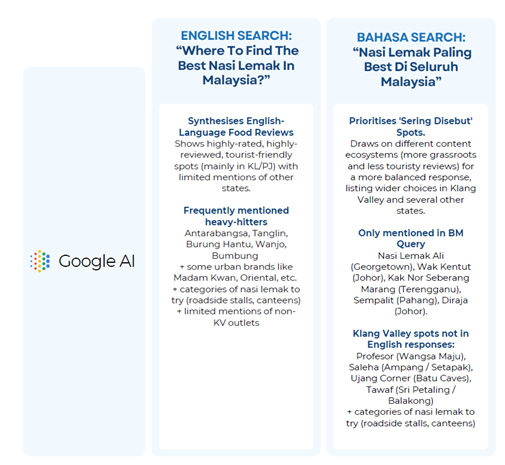
For example, the research discovered that GenAI recommendations for “best nasi lemak” in English-language queries were heavily focused in the Klang Valley. In contrast, the same query in Bahasa Malaysia reflected more diverse options across states in Peninsular Malaysia.
This is because most English reviews of “nasi lemak” are by major content creators and tourists, who mainly focus on the Klang Valley. In contrast, Bahasa Malaysia recommendations are more often found in personal blogs, social media and Malay-language forums, resulting in more diverse and grassroots-focused AI recommendations.
This finding is one of the many key insights in the white paper, which explored how different GenAI platforms – specifically ChatGPT, Gemini, DeepSeek, Copilot and NurAI – recommend brands and products across different sectors. The rise of GEO is a game-changing shift from the current SEO-based content ecosystem. Brands now need to optimise for GenAI discoverability and recommendations or risk being invisible.
Understanding how GenAI answers Malaysian consumer questions is crucial for brand and reputation building in the current AI-driven era. Consumers are increasingly getting answers immediately from their favourite GenAI platform and acting on the answers.
From where to study and what to buy, to which brands are best suited for them, these digital Key Opinion Leaders (KOL) are shaping consumer opinions and trust.
Experts project that GenAI will command over half of all worldwide search by 2030. This highlights the urgency for brands to adapt to this new reality.
“Our study highlights a fundamental shift in how influence is built. GenAI is fast becoming the gatekeeper between consumers and brands. Brands can no longer rely solely on owned channels and official narratives as the single source of truth in the market.
GenAI synthesises its answers from a variety of sources, with greater priority given to trusted sources and real consumer sentiment online,” said Andy See, Managing Director of Perspective Strategies.
The research also revealed that each GenAI platform has its own unique strengths and characteristics, which creates differences in how they answer consumer queries. This adds another layer of complexity for brand discovery in the AI era.
Commenting on the findings, Lai Chee Seng, the white paper’s Head of Research and Insights, shared that GenAI answers reflect existing online content from various digital platforms that are recognised as trustworthy by algorithms.
“Our research revealed that smaller brands were often surfaced alongside established brands in GenAI answers, putting them on equal footing. Established names were sometimes completely left out of GenAI answers.
This points to both risk and opportunity for brands seeking to win consumer attention and trust. Brands need to urgently evaluate their content ecosystems and engineer for AI discovery,” he said.
“The essential takeaway would be this: the human element is still the most crucial success factor in GEO. As GenAI engines are optimised to support user intent, the ability to deeply understand and empathise with the psychology of your target audience is crucial to creating content ecosystems that win in GEO”, he added.
Andy added that the rise of GenAI elevates the role of public relations and communications in managing long-term influence rather than short-term visibility.
“Reputation management in this day and age now extends to how your brand or organisation is presented by these GenAI platforms, and how it is presented to users at critical decision-making moments. Besides AI technical fluency, the human factor is crucial and we need to start preparing our workforce for this new reality now.”