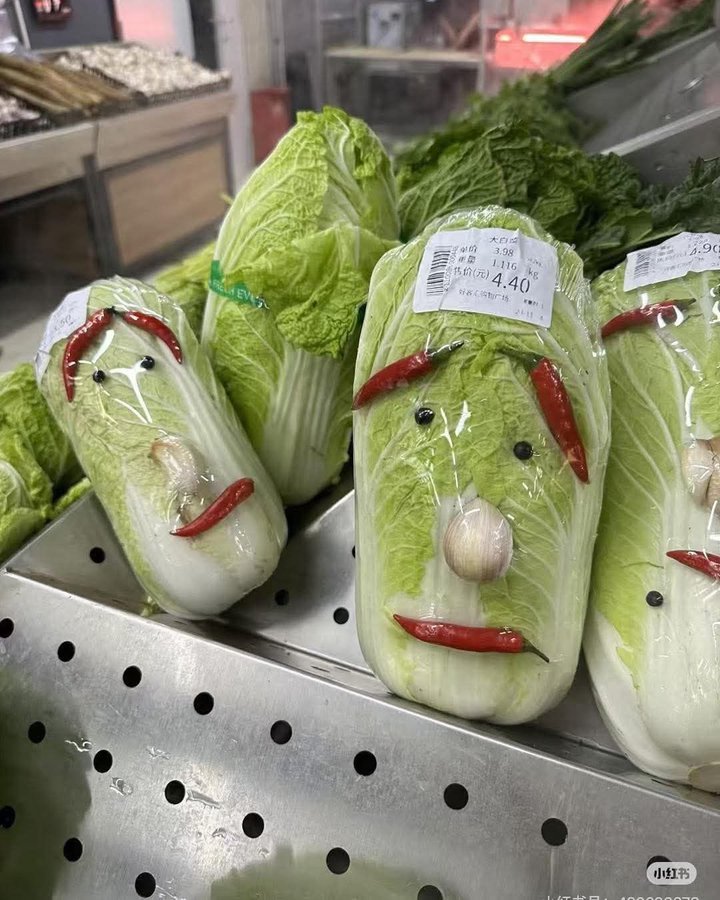
There was a time when the produce aisle sold on quiet virtues. Freshness. Price. Maybe a handwritten sign promising “just arrived this morning.” Today, it seems, even a cabbage needs a personality.
A recent report by Focus Malaysia tells of a supermarket display that has done what countless promotional campaigns struggle to achieve: stop people mid-scroll, mid-step, mid-thought.
The trick was disarmingly simple.
A few cabbages, dressed up with seed “eyes”, chilli “eyebrows” and an onion “nose”, sealed neatly under plastic to hold the expression in place.
Not quite art. Not quite merchandising. But unmistakably human. A viral moment that travelled far beyond the store that conceived it.
Aisle Theatre in the Age of Scroll
Walk into most supermarkets and the experience is functional by design. Fluorescent lighting, predictable layouts, a rhythm built for efficiency. You pick, you weigh, you leave.
What this anonymous employee did was interrupt that rhythm. The cabbages didn’t just sit on a shelf. They looked back.
That subtle inversion matters. In a digital culture trained on faces, reactions and expressions, the human brain is wired to respond to anything that resembles a gaze.
It is the same instinct that makes emojis powerful and reaction videos addictive. Here, it played out in the most unlikely setting: a vegetable display.
Social media did the rest. Comments ranged from amused admiration to mock discomfort.
Some said they would buy the cabbages immediately. Others admitted they might hesitate to cook something that appeared to be watching them.
Either way, the product had done something rare. It had entered conversation.
The Psychology of the Mundane
Marketers spend millions trying to create memorability. Yet this small act leans on something far older and far cheaper: anthropomorphism.
Give an object a face and it acquires a story. Give it an expression and it invites interpretation.
Suddenly, a cabbage is no longer just a cabbage. It is “angry”, “sad”, “curious”. It becomes shareable because it becomes relatable.
In behavioural terms, this is low-effort engagement with high recall. The shopper does not need to process a message or decode a claim. The reaction is immediate, almost instinctive.
A smile. A laugh. A photo taken and posted. In a crowded retail environment where every brand is shouting for attention, instinct beats instruction.
When Shelf Space Becomes Media Space
There is a broader shift here that marketers would do well to notice.
Physical retail is quietly borrowing from the playbook of social platforms. The supermarket shelf is no longer just a point of sale. It is a stage. A piece of content waiting to happen. For decades, packaging design has carried the burden of differentiation.
Colour, typography, claims. But what this cabbage episode suggests is that context can be just as powerful as design. The way a product is presented in situ can transform it into something far more dynamic.
It also democratises creativity. This was not the work of a major agency or a multimillion-ringgit campaign.
It was likely conceived and executed at store level, by someone who understood, perhaps instinctively, what would make people look twice.
There is a lesson in that humility. Not all effective marketing needs scale. Sometimes it needs permission.
The Fine Line Between Charm and Discomfort
Of course, not everyone was charmed.
Some online reactions pointed to an unease. There is something slightly uncanny about food that appears sentient. A cabbage with a face is amusing. A cabbage that stares too intently might cross into discomfort.
This tension is worth noting. The same device that draws attention can also repel. In marketing terms, it is the difference between intrigue and friction.
Yet even the discomfort plays a role. It extends the conversation. It invites commentary. It keeps the product in mind a little longer than a standard display ever could.
A Small Idea with a Long Tail
What lingers is not just the image of those cabbages, but the implication behind them.
In an era where brands chase algorithms and audiences fragment across platforms, a simple in-store idea managed to bridge the physical and digital worlds effortlessly.
No media spend. No influencer brief. Just a moment that people felt compelled to share. For Malaysian retailers and marketers, the takeaway is not to start putting faces on every vegetable in sight.
It is to recognise that attention today is earned through surprise, through wit, through an understanding of how people behave both in-store and online.
The produce aisle may never look the same again.
Not because every cabbage will have a face, but because the bar for what counts as “just a product” has quietly shifted.
Branding has seeped into even the most ordinary corners of retail. The difference now is that the most effective branding does not always announce itself. Sometimes, it simply looks back at you.
Share Post:


The APPIES is where Malaysia’s boldest campaigns, brightest ideas, and most impactful storytellers take the stage.
More than an awards show, it is the industry’s ultimate platform for creative, media, digital and marketing excellence, where live presentations meet live judging.
This is your chance to showcase work that moved audiences, shaped conversations, and delivered real results.
From breakthrough brand campaigns to innovative digital experiences, the APPIES celebrates the work that defines the future of marketing.
Step into the spotlight alongside the industry’s leading agencies, brands, creatives, strategists and changemakers.
Whether you are aiming for Gold, Silver, Bronze or the prestigious Best of the Best recognition, this is your moment to make history.
Your campaign deserves to be seen.
Your ideas deserve the stage.
Your work deserves the legacy.
KEY DATES
Haven’t subscribed to our Telegram channel yet? Don’t miss out on the hottest updates in marketing & advertising!