By Ezra Gideon
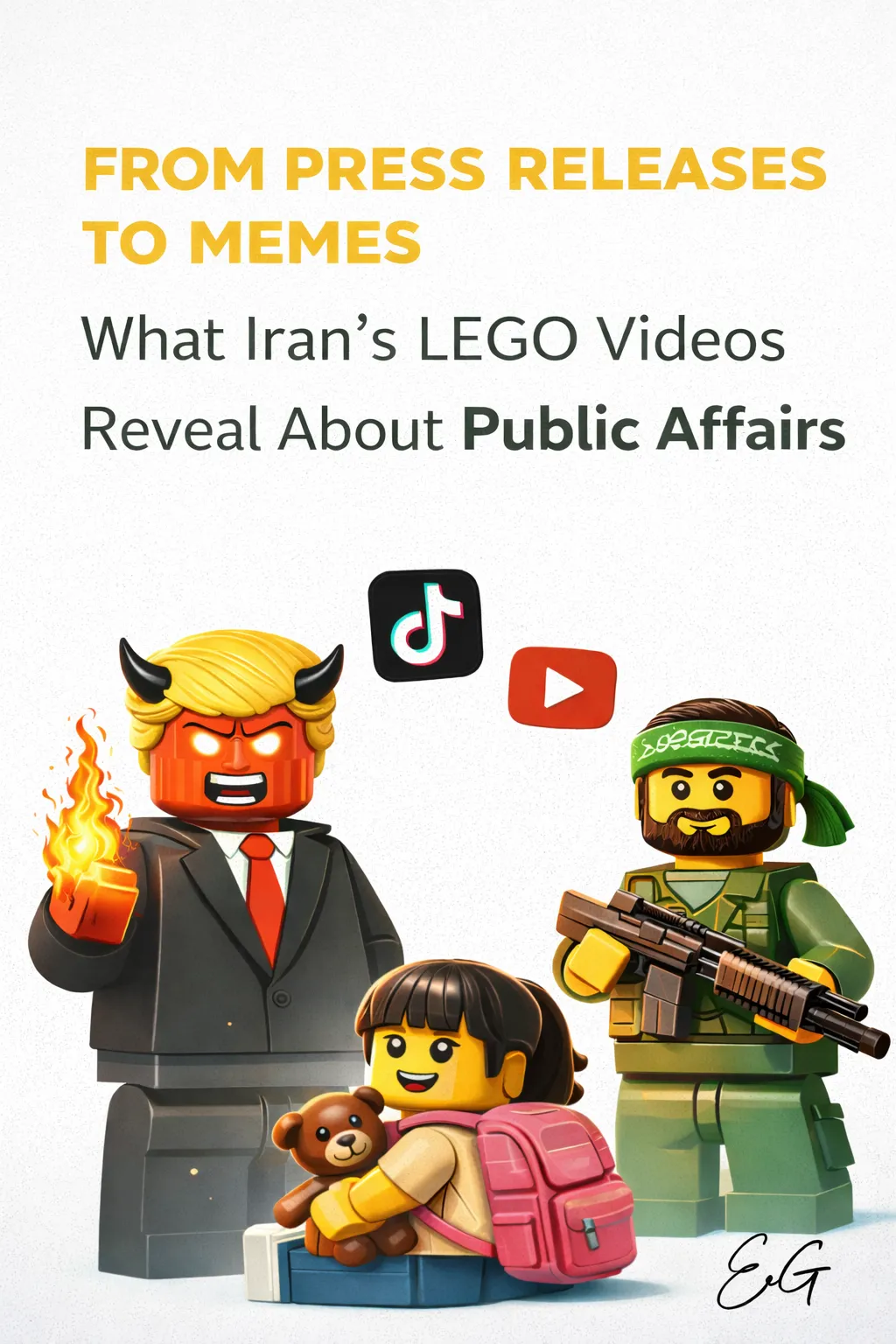
Iran dropped a LEGO rap video last month, and a few more after that. Trump as Satan. Netanyahu holding an Epstein file. A missile hits a girls’ school, with a zoom-in on a pink little school bag.
It was whack. It was dramatic. It was also brilliant.
Within days, it went viral worldwide. Not because anyone believed the propaganda, but because it was shareable. Funny. Culturally fluent. Built for algorithms in a way that traditional PSAs have never been.
What’s easy to miss is that this isn’t just one video. It’s a pattern.
Watch how Iranian embassies move on X now. They don’t fire off press releases and wait for coverage. They post memes. They reply to Trump with a joke about losing the keys to the Strait. They tell a Thai audience that the US president sounds like a teenager. They quote Mark Twain for the UK.
These are official accounts, diplomatic channels. But they’re not acting like diplomats anymore. They’re acting like everyone else on your feed, reposting, remixing, amplifying. Different jokes for different audiences. Same message underneath.
AP News noticed the shift. But the real story isn’t the video. It’s that the embassy doesn’t just announce a position anymore. It participates in the conversation.
This is information warfare.
Just adapted to the platforms people actually use.
Iran has very little traditional soft power in the United States, if any. And yet they outmanoeuvred the world’s most sophisticated public affairs machine. Not with facts. Not with press releases. With a meme.
This feels like a turning point where the old playbook goes to die.
For decades, public affairs meant one thing: craft a message, feed it to journalists, measure column inches.
That world is gone now.
Younger audiences do not watch the evening news. They get information from TikTok, YouTube, Reddit, Substack, and creators they trust. Engagement with traditional media has dropped sharply, while alternative media has exploded. As PR practitioners, I am sure we have all felt this coming for some time now.
But the deeper shift is not just about channels. It is about how meaning is made.
Welcome to memetic warfare: the deliberate use of humour, cultural symbols, and participatory spread to shape perception without the audience ever feeling like they are being persuaded.
Case study: Iran’s LEGO offensive
Strip it back, and here is what they actually did.
Iran created AI-generated LEGO animations with clear villains: Trump and Netanyahu. They placed innocent victims in a girls’ school. They showed heroic retaliation with Iranian missiles striking back. They embedded Western pop culture references, including Trump’s “You’re fired” from The Apprentice. Then they released everything across platforms designed for algorithmic virality.
Why did it work?
One professor told CNBC that Iran combined grievances with internet pop culture. They wove together the Epstein case, anti-war sentiment, and meme aesthetics to reach scattered Western audiences. The LEGO format lowers psychological resistance. You are smiling and bopping your head before you realise what you are watching.
The video was set to a hard, bass-heavy trap beat, the kind you would hear in a gym or a car commercial. Familiar production lowers suspicion. That is cultural intelligence. A very important aspect of public affairs.
The US fired back with video games
The White House response was just as revealing, though arguably more troubling.
They began splicing real strike footage with clips from Call of Duty, Mortal Kombat, SpongeBob SquarePants, and Top Gun. One video ended with the audio: “Flawless victory.”
When CNN aired a segment questioning the approach, the communications director responded on X. He thanked them for covering “all of our banger videos” and then posted a Grand Theft Auto cheat code.
Four videos got nearly 100 million views in three weeks. But they did not spread around the globe as well as Iran’s LEGO rap video. The US videos played well domestically. They just did not have the same cultural portability.
Sure, it worked. For home consumption.
The bit we keep scrolling past
First, desensitisation. When war footage is cut like a video game trailer, something fundamental breaks in how audiences process violence. One of my colleagues here at The Hoffman Agency, Isyah, put it well: when political information becomes entertainment, people accept emotion, not just facts. I agree. Combine the two, and you have a banger.
Second, credibility. Memes win moments. They do not build trust.
I spent five years at Edelman doing regional work as Director of Public Affairs, presenting the Trust Barometer to clients. The 2025 Trust Barometer found that 68% of people now believe business leaders deliberately mislead the public, up 12 points from 2021. Even more striking, 70% say the same of government officials and journalists.
People are tired of performative content. They can smell spin. And when brands chase short-term wins with virtue signalling or inflated claims, they do not build credibility. They accelerate the erosion.
Third, the moral hazard. A retired Army colonel, Joe Buccino, who served as a CENTCOM spokesperson for 27 years, called the White House videos nauseating. Packaging combat as entertainment trivialises human cost. He is not wrong.
What this means for public affairs
The Iran-US meme war is not an anomaly. It is a signal.
The old rules assumed audiences are rational, trust flows from authority, and message control is possible. The new reality is different. Audiences co-create meaning. Cultural fluency beats message discipline. You do not control the story. You start a conversation and trust where it goes. Yes, trust. That currency you cannot afford to be in the red with.
Consider this: a Deloitte study found that 17% of Gen Z now rely on AI chatbots for news summaries, and a third never click through to the source. I do the same thing; I use a dashboard for my daily two to three hours of news. That is the environment in which Iran’s LEGO video entered. Not a news cycle. A filter.
In fact, one Chinese analysis introduced a concept called “symbolic equality.” AI and social media have democratised cultural production to the point where Iran can compete with the US on almost equal footing in the information space. Budget matters less. Cultural fluency matters more.
One more thing. Just something I noticed.
Lego has a strict anti-war policy. They have enforced it before. In 2020, they cancelled a V-22 Osprey set after protests. I should mention that Lego was a client of ours at Edelman, so I have seen up close how seriously they take brand protection.
This time? Nothing. No statement. Silence.
Lego is Danish. Denmark is currently in a sovereignty dispute with the US over Greenland. Donald Trump wants it. Denmark has refused.
Maybe the AI videos are harder to fight. Or maybe a Danish company simply does not want to pick a fight with Iran while its own country is in a dispute with the same administration.
Too early to say. But if I were sitting in their public affairs office, I would notice. Which means people in much nicer suits than mine have likely noticed too. The silence is telling.
My take
That LEGO video was built to travel. And that is the shift.
It also did something more subtle. It made Iranian voices feel familiar. Same humour. Same references. Same cultural cues. And in doing so, it narrowed a distance that has been carefully maintained for years.
Narrative today is not about what you say anymore. It is more about how you say it, what’s trending and what people choose to share.
We have moved from messaging to memetics. From broadcast to participation. From control to something a lot more fluid.
Public affairs is already adapting. You can see it happening in real time.
The question is whether the rest of us are keeping up.
Ezra A. Gideon, IABC, Washington, D.C., is a senior strategist, speech and signal writer, analysing shifting global patterns through an ASEAN lens. A public affairs guy and Liverpool fan, mostly watching how the story moves, not just how it lands.
Share Post:

The APPIES is where Malaysia’s boldest campaigns, brightest ideas, and most impactful storytellers take the stage.
More than an awards show, it is the industry’s ultimate platform for creative, media, digital and marketing excellence, where live presentations meet live judging.
This is your chance to showcase work that moved audiences, shaped conversations, and delivered real results.
From breakthrough brand campaigns to innovative digital experiences, the APPIES celebrates the work that defines the future of marketing.
Step into the spotlight alongside the industry’s leading agencies, brands, creatives, strategists and changemakers.
Whether you are aiming for Gold, Silver, Bronze or the prestigious Best of the Best recognition, this is your moment to make history.
Your campaign deserves to be seen.
Your ideas deserve the stage.
Your work deserves the legacy.
KEY DATES
Haven’t subscribed to our Telegram channel yet? Don’t miss out on the hottest updates in marketing & advertising!