
By Prabhvir Sahmey. Founder CEO, Stratpulse Techlabs
For decades, cinema advertising operated on a model that felt almost anachronistic even by traditional media standards: fixed inventory, manually negotiated packages, and campaign delivery that offered little more than a postcode and a film genre as targeting signals. That is beginning to change.
The timing is not coincidental. Both regions have witnessed a strong post-pandemic resurgence in theatrical attendance, driven by a pipeline of local-language blockbusters that continue to outperform Hollywood titles in domestic box offices.
Why Programmatic Cinema Is Gaining Traction or Relevant Now?
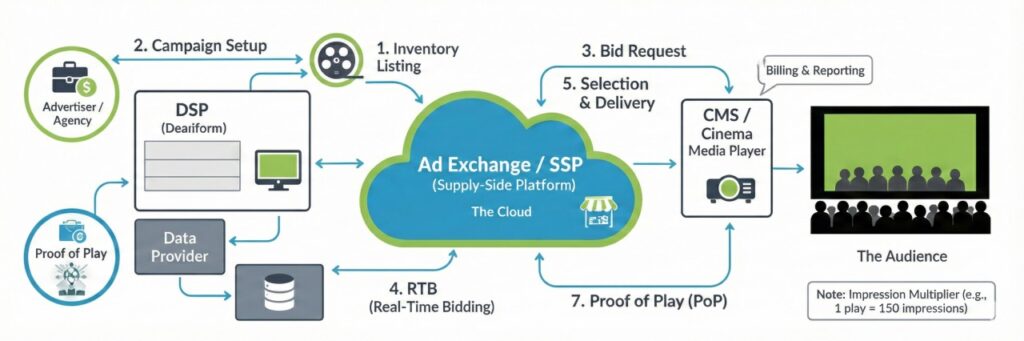
The primary driver is workflow alignment. Large brands increasingly buy video through DSPs, centralizing budgets across CTV, online video, and digital out-of-home. Cinema, despite its premium positioning, has remained outside these pipes. Programmatic enablement doesn’t necessarily mean real-time bidding per show; rather, it allows cinema to plug into agency planning, reporting, and deal-management systems.
Second, cinema’s value proposition has sharpened in a fragmented attention economy. Large-format, unskippable advertising in a dark auditorium offers what digital often struggles to deliver: undivided attention. For national advertisers seeking impact at scale—particularly in theatrical tentpole moments—cinema provides a complementary channel to television and premium streaming.
Third, multiplex chains across the region have modernized projection and ticketing systems. Centralized scheduling, digital media players, and API-based ticketing exports make showtime-level inventory management more feasible than it was a decade ago. That operational digitization is a prerequisite for any programmatic overlay.
What programmatic technology promises, on top of this renewed audience interest, is efficiency: the ability for brands to activate campaigns across hundreds of screens at short notice, with targeting parameters that go beyond what a traditional booking desk can offer.
Structural Challenges Remain
Despite the optimism, cinema is not a plug-and-play digital channel.
Ad certification remains a material constraint. Cinema attracts diverse age groups, and many markets require creative to be certified as suitable for broad audiences. Any programmatic infrastructure must embed certification checks before allocation and playback, introducing an additional compliance layer absent in most digital environments. This is a mandatory check in India.
Measurement is another hurdle. While ticketing systems provide occupancy data, cinema lacks user-level identifiers. Impressions are typically derived from attendance multiplied by ad exposure. For advertisers accustomed to device-level reporting and attribution, this shift requires expectation management and standardized reporting frameworks. And, with new privacy norms around the corner. Such cross-device measurement platforms viability is also at risk without compromising PII. One is waiting for a clean data room solution to drive some of this.
Finally, the bid-request windows common in SSP environments do not align with cinema’s pre-scheduled playback. This limits the viability of true real-time bidding and instead favors automated direct or PG models, where allocation decisions occur hours—or days—before showtime. There is also a restriction that was recently introduced by different SSP; which requires the bid request to come in at a maximum of 1 hour before the ad is to be shown. And, if you are on Google; it must render immediately.
This was done to minimize fraud of impressions being injected without the file being played.
Other challenges beyond the ad stack are, that each multiplex chain and screen network may have different delivery systems, file format requirements, and booking lead times — making true programmatic execution, as opposed to automated-but-sequential booking, genuinely difficult to implement at scale.
It is a white space for a tech platform to solve for the region if they can navigate the complexity of the business both with infrastructure and process/compliance requirements. It may not be real time; but it will be programmatic.
Market Stats
India — 2025 Baseline. Cinema ad market estimated at ~Rs 950 crore (~USD 130–229M depending on source). Less than 1% of total Indian adex. Source: Pitch-Madison 2025; Statista; IMARC
India — 2030 Forecast. Projected ~USD 317M at a CAGR of ~6.7% (2025–2030). Source: Statista
SEA Box Office. Regional box office projected to reach ~USD 1B by 2029, growing at ~5.85% CAGR. Source: Statista
SEA Advertising Market~USD 28B in 2025, projected to reach ~USD 64B by 2031 at ~14.5% CAGR. Cinema remains a small but growing slice. Source: Mordor Intelligence